
Optimizing a Pool Pump from 65 to 45 GPM
61% Less Energy, About $383/Year Saved
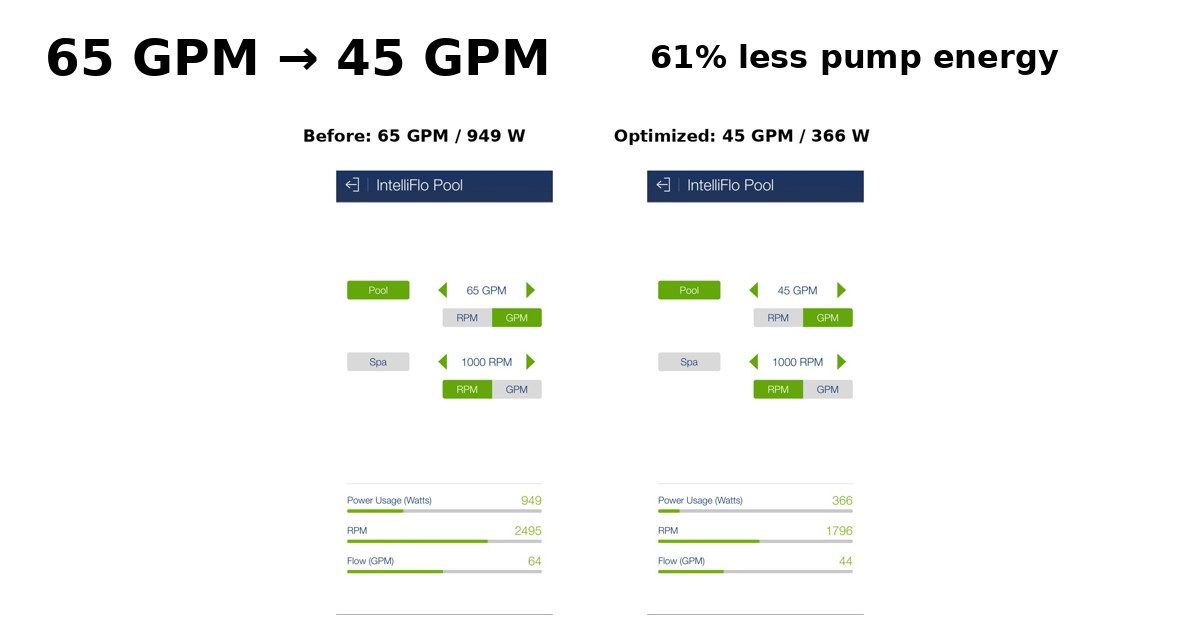
I originally ran the main pump at 65 GPM for 12 hours a day because the spa spillover looked great and the skimmer had plenty of flow. But the pump was drawing 949 W. Since it is a variable-flow system, I tested 30 to 65 GPM in 5-GPM steps and compared power, RPM, filter pressure, surface flow at the skimmer, the Pool Cooler stream, and the spa spillover. The final setting was 45 GPM for 12 hours.
Bottom line first
- The original schedule was 65 GPM × 12 h/day: 949 W measured, or 11.388 kWh/day.
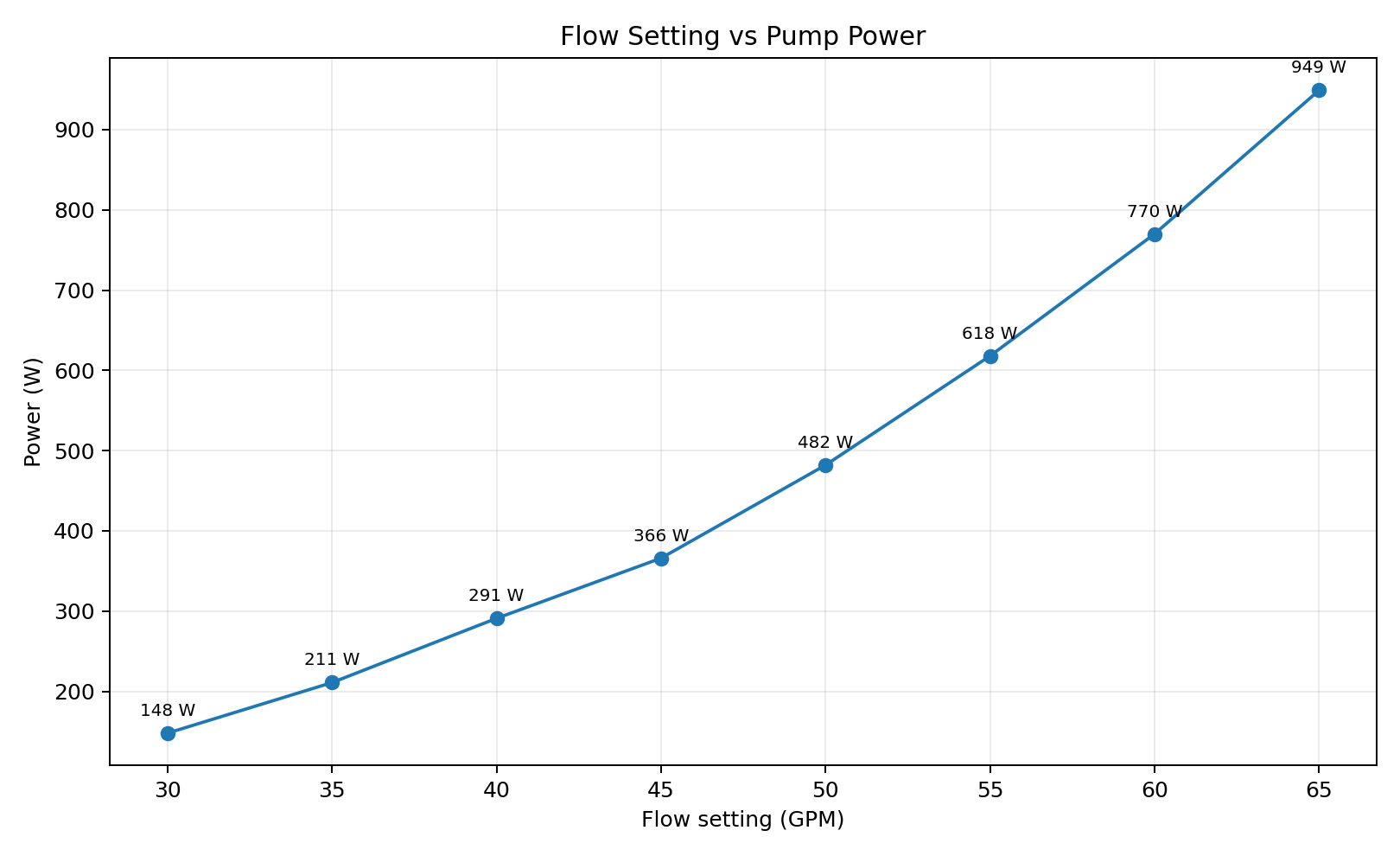
- Testing every 5 GPM from 30 to 65 showed 148 W at 30 GPM and 770 W at 60 GPM. Doubling flow increased power by about 5.2× on this system.
- 30–40 GPM used less power, but I wanted to keep a practical level of surface flow at the skimmer. 45 GPM was the lowest practical setting for my pool.
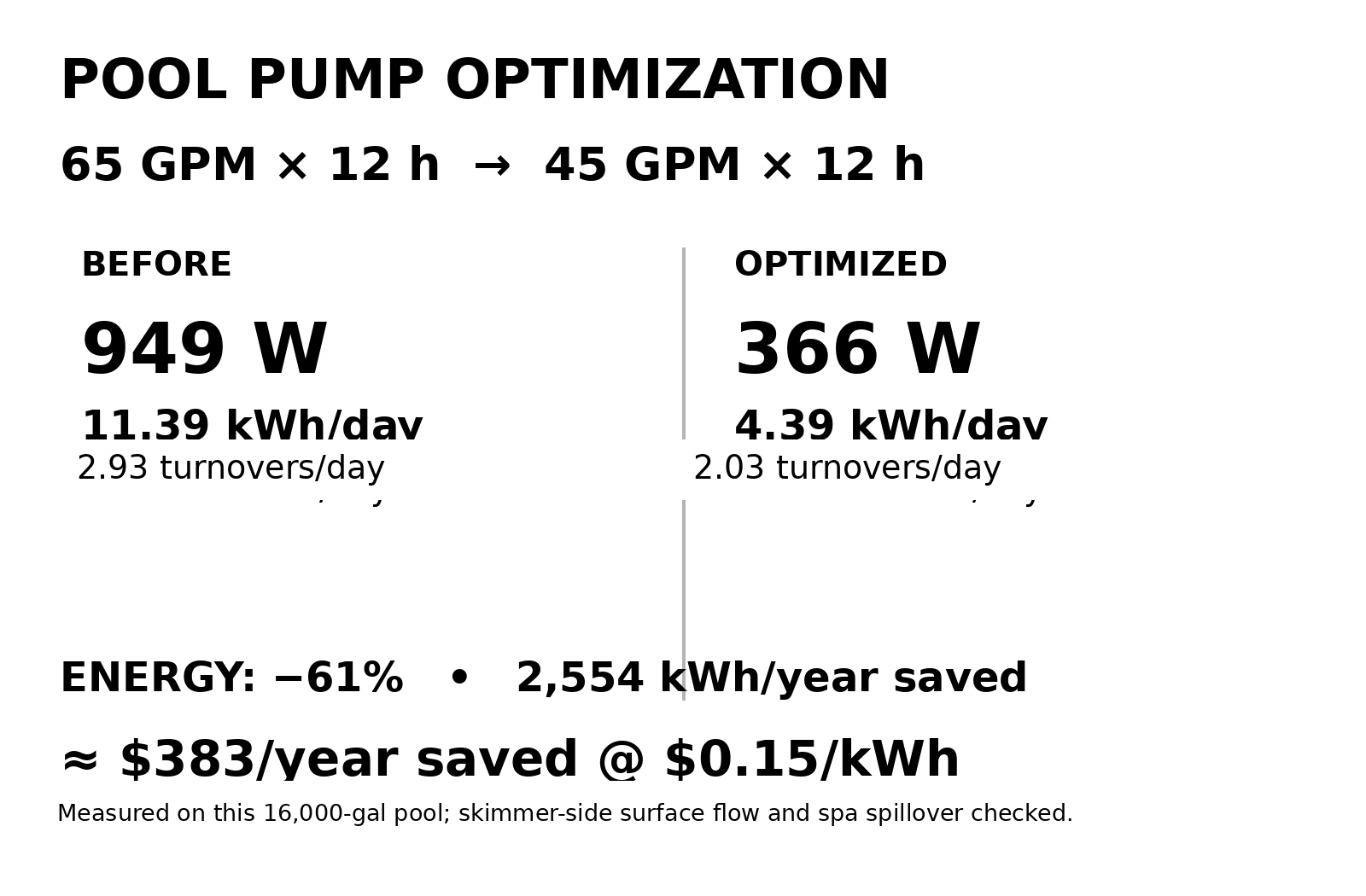
- At 45 GPM × 12 h/day, measured power was 366 W, or 4.392 kWh/day. The setpoint calculation gives about 2.03 turnovers/day for a 16,000-gallon pool.
- The change from 65 to 45 GPM cut pump energy by about 61.4%: roughly 2,554 kWh/year, or about $383/year at $0.15/kWh.
1. The starting point: 65 GPM for 12 hours looked great, but drew 949 W
I initially ran the main pool pump at 65 GPM for 12 hours per day. The spa spillover had a strong, attractive flow, the surface moved well, and the skimmer had plenty of draw. Visually, it looked like a setting that was doing its job.
The IntelliFlo Pool app, however, showed 949 W / 2,495 RPM / 64 GPM at the 65-GPM setpoint. Over 12 hours, that is:
That raised the obvious question: if the pump can vary its flow, do I really need to push this much water every day? I decided to look at flow, power, and actual water movement together, rather than focusing on run time alone.
2. Run time alone is not enough: flow and turnover matter too
Pool circulation is often discussed as “how many hours per day,” but 12 hours at 30 GPM is a very different amount of water than 12 hours at 65 GPM. Turnover is a useful secondary check:
I previously estimated this pool at about 15,972 gallons using Google Earth surface area and measured depth, and I use 16,000 gallons as the working baseline. Read the pool-volume estimate →
At 65 GPM for 12 hours, the setpoint calculation is 46,800 gallons per day, or about 2.93 turnovers/day.
3. Testing 30 to 65 GPM in 5-GPM steps
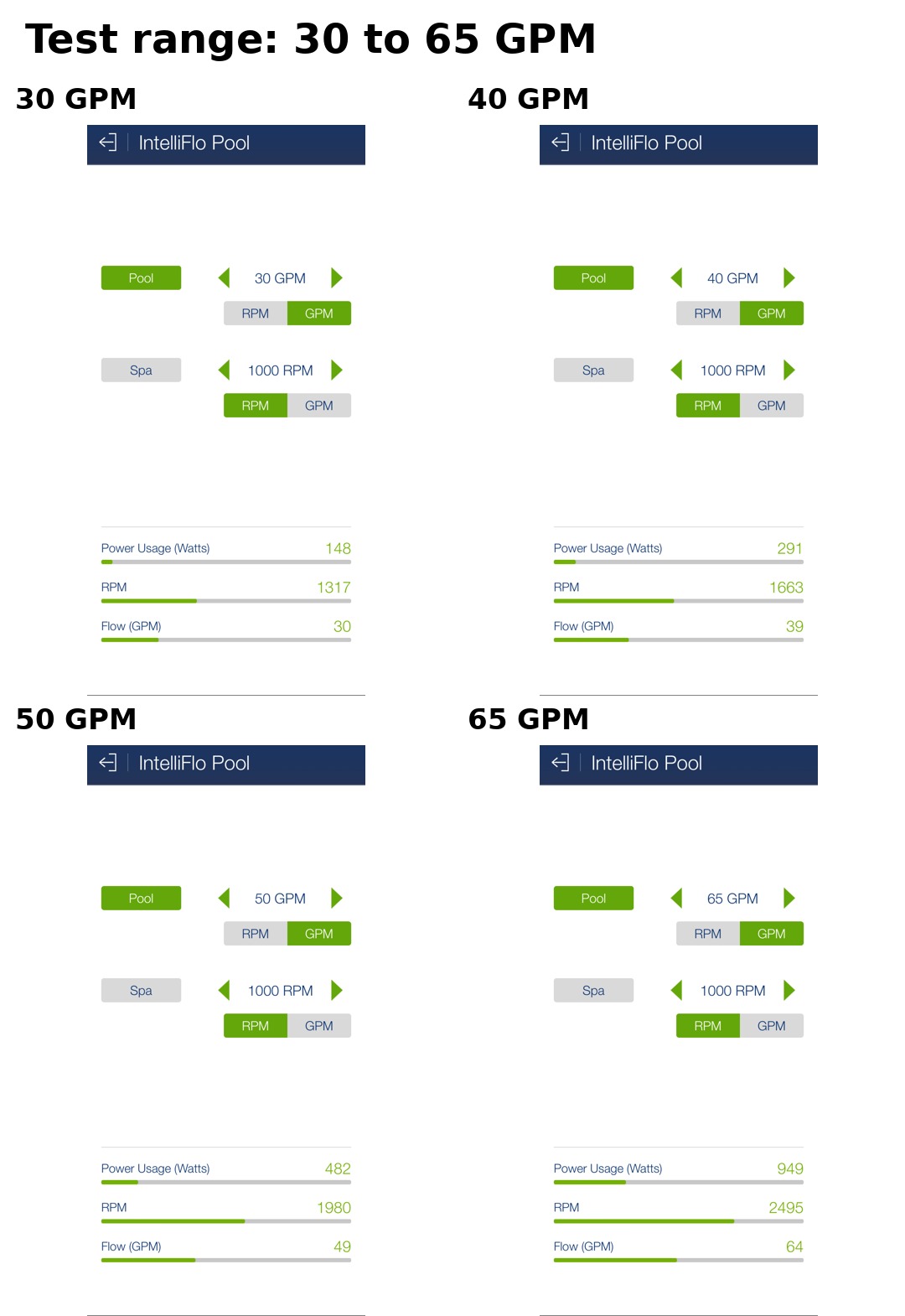
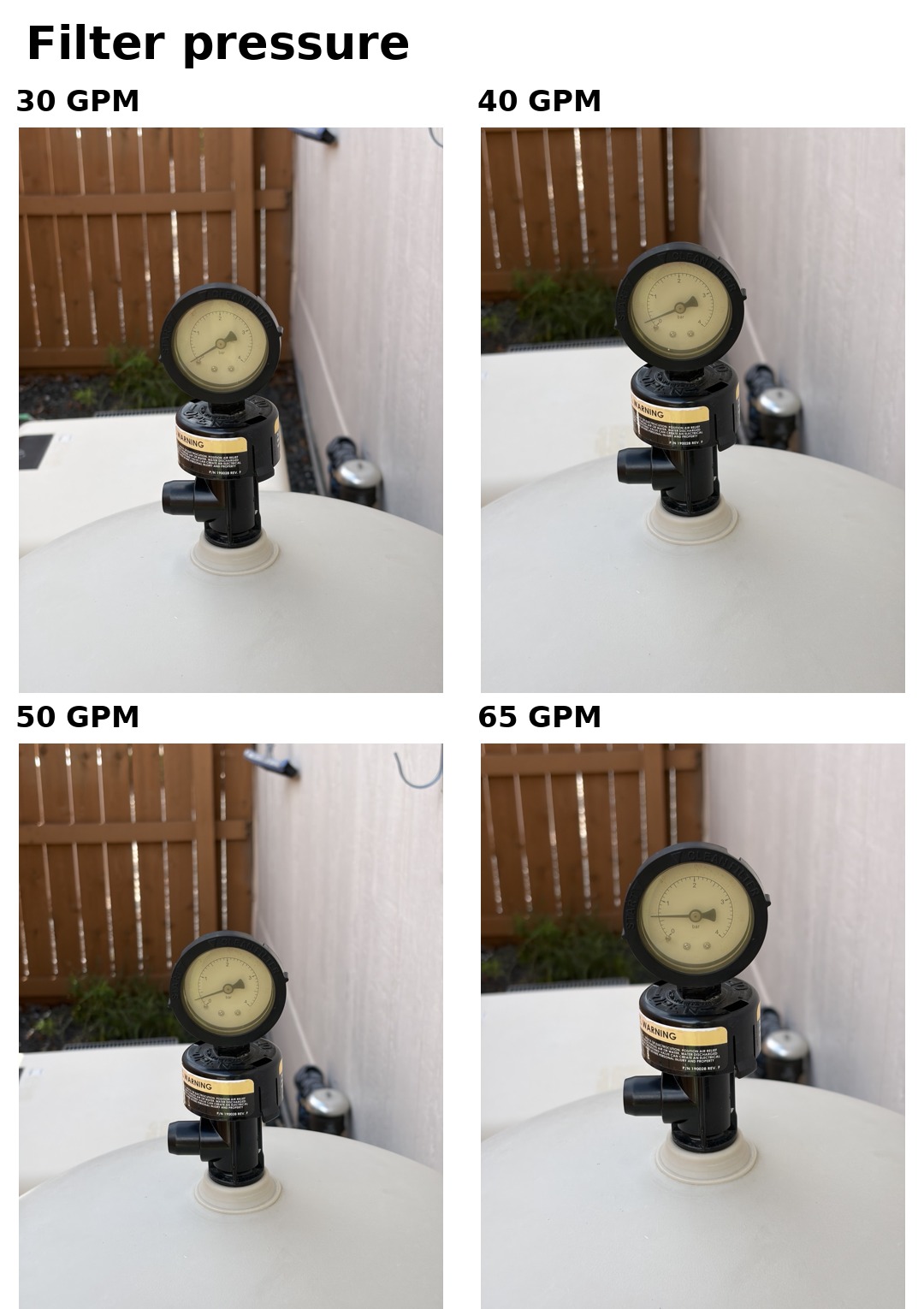
With the same plumbing and valve positions, I set the pump to 30, 35, 40, 45, 50, 55, 60, and 65 GPM. At each point I recorded the app's displayed flow, RPM, and power. I also photographed the analog filter-pressure gauge and recorded video of the skimmer, Pool Cooler stream, and spa spillover.
| Flow setpoint | Displayed flow | RPM | Power |
|---|---|---|---|
| 30 GPM | 30 GPM | 1,317 | 148 W |
| 35 GPM | 34 GPM | 1,484 | 211 W |
| 40 GPM | 39 GPM | 1,663 | 291 W |
| 45 GPM | 44 GPM | 1,796 | 366 W |
| 50 GPM | 49 GPM | 1,980 | 482 W |
| 55 GPM | 55 GPM | 2,154 | 618 W |
| 60 GPM | 60 GPM | 2,324 | 770 W |
| 65 GPM | 64 GPM | 2,495 | 949 W |
4. Doubling flow from 30 to 60 GPM increased power about 5.2×
The clearest comparison is 30 versus 60 GPM. Flow doubles, but measured power rises from 148 W to 770 W:
This direction is consistent with why lower-speed operation saves so much energy on variable-speed pool pumps. ENERGY STAR recommends matching pump speed to the task rather than using a high speed for everything[2]. The U.S. Department of Energy's pool-pump guidance explains the nonlinear relationship using the pump affinity laws[3].
My plumbing system is not an idealized affinity-law example, but the measured result is still very clear: high flow gets expensive quickly.
5. So why not 30 GPM? I still wanted practical surface flow at the skimmer
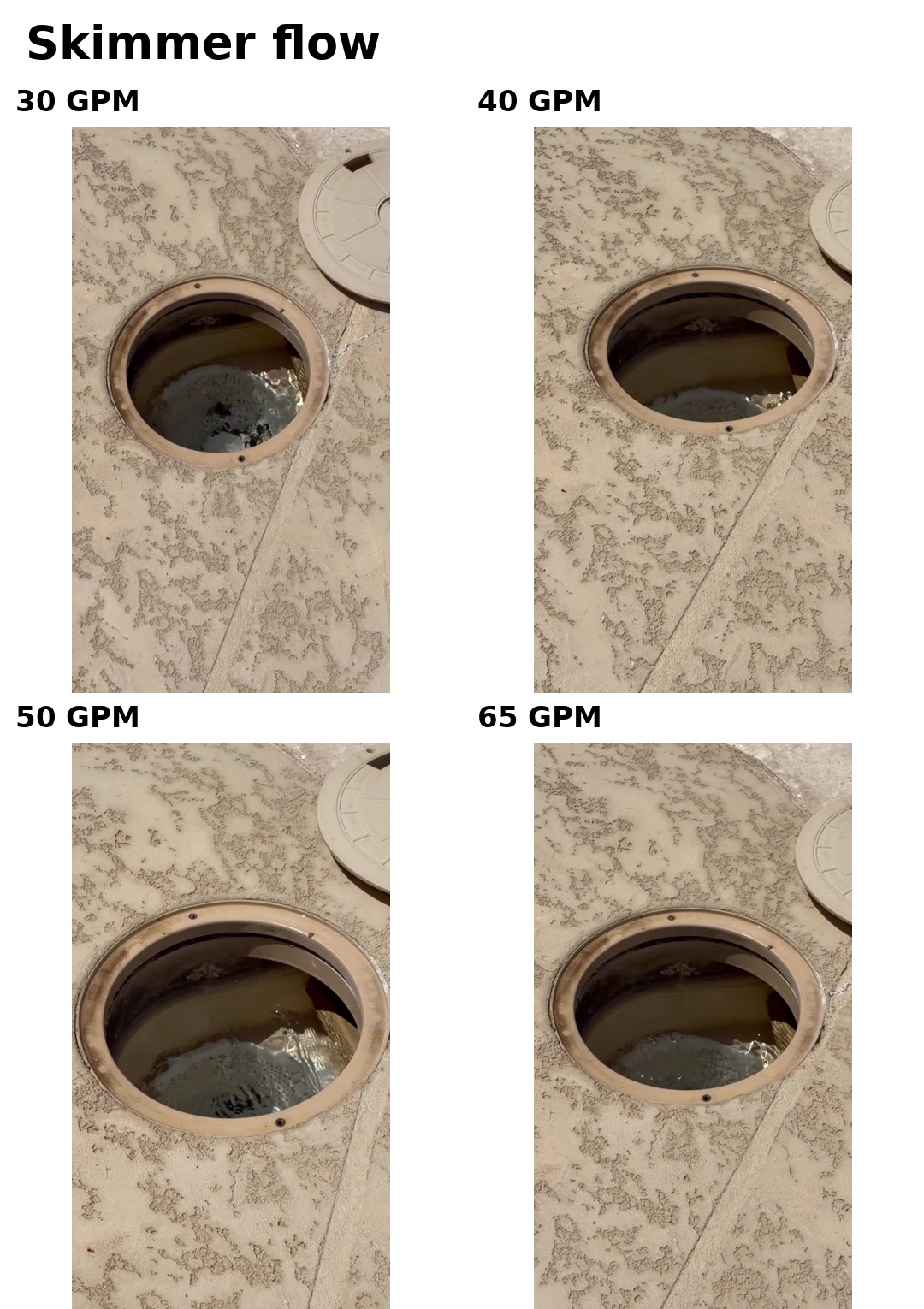
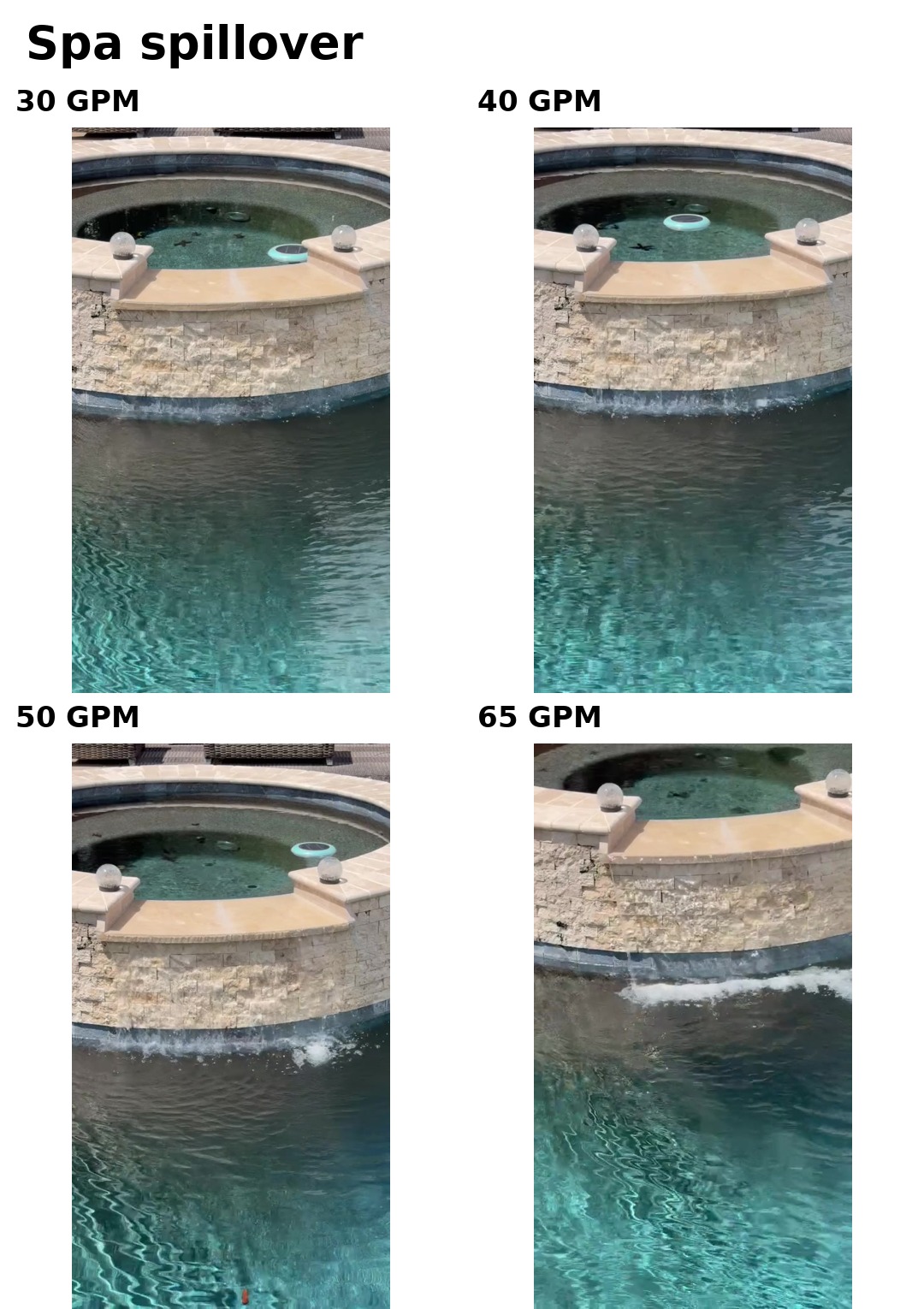
If electricity were the only goal, 30–40 GPM would win. But a pool pump is not a “minimum-watts” contest. I still need filtration circulation, practical surface flow around the skimmer, and a reasonable spa spillover.
At the lower settings the system still circulated water, but the surface flow around the skimmer became weaker. Based on the videos and normal day-to-day use, I did not want to reduce it further. The 65-GPM spillover looked strong, but I did not need that much flow just for appearance. At 45 GPM, the spa still had a continuous spillover and the skimmer area still showed practical surface movement.
Do not choose the absolute lowest wattage. Choose the lowest flow that still does the job. For this pool, that was 45 GPM.
I also recorded the Pool Cooler stream at each setting. The separate cooling experiment is here: Does a Pool Cooler actually work in a 16,000-gallon pool? →
6. Checking the final setting: about 2.03 turnovers/day
After choosing 45 GPM based on actual operation, I checked the circulation volume:
The app showed 44 GPM at that setpoint, which would be 31,680 gallons/day, or about 1.98 turnovers/day. I use the setpoint for schedule calculations and keep the app reading separate in the measured-data table.
PHTA-5 (2024) gives residential in-ground pool filtration-flow limits based on a six-hour turnover maximum flow, a 12-hour minimum flow, and a 36-GPM floor. It also encourages lower filtration flow rates and longer filtration times for energy savings[1].
For a 16,000-gallon pool, those formulas work out to roughly 36 to 44.4 GPM. The 44-GPM app reading at my 45-GPM setpoint happens to sit near the top of that range.
7. The result: 61% less pump energy and about $383 per year
Because the daily run time stayed at 12 hours, the before/after energy comparison is straightforward.
| 65 GPM × 12 h | 45 GPM × 12 h | Difference | |
|---|---|---|---|
| Measured power | 949 W | 366 W | −583 W |
| Energy / day | 11.388 kWh | 4.392 kWh | −6.996 kWh |
| 30 days @ $0.15/kWh | About $51.25 | About $19.76 | About $31.48 saved |
| 365 days @ $0.15/kWh | About $623 | About $240 | About $383 saved |
I use $0.15/kWh because it is close to my actual effective electricity cost. For context, EIA's July 2026 data show an average Texas residential electricity price of 15.88¢/kWh[4]. That statewide average is not the same as an individual retail contract, but it confirms that 15¢/kWh is a reasonable order-of-magnitude assumption here.
This cost comparison covers the main pump at these 12-hour settings only. Separate Polaris or waterfall run times are not included.
Conclusion: not the lowest watts—the lowest flow that still does the job
The energy difference was much larger than I expected. At 30 GPM the pump used only 148 W, but chasing the absolute minimum power would mean accepting weaker surface flow around the skimmer than I wanted for normal use.
After comparing power, surface flow around the skimmer, and the spa spillover, I settled on 45 GPM for 12 hours per day. That changed daily pump energy from 11.388 to 4.392 kWh—about a 61% reduction—without giving up the practical behavior I care about.
Instead of asking only “How many hours should I run the pump?”, it was more useful to ask “Do I really need this much flow?” If you have a variable-speed or variable-flow pool pump, measuring GPM and watts side by side can reveal a surprisingly large optimization opportunity.
References
- Pool & Hot Tub Alliance, PHTA-5 Standard for Inground Residential Swimming Pools (2024) (filtration-flow limits and encouragement of lower flow / longer filtration)
- ENERGY STAR, Pool Pumps (matching variable-speed operation to pool functions and lower-flow filtration)
- U.S. Department of Energy / Building America, Measure Guideline: Replacing Single-Speed Pool Pumps with Variable Speed Pumps for Energy Savings (pump affinity laws)
- U.S. Energy Information Administration, Electric Power Monthly, Table 5.6.A, July 2026 (Texas residential average: 15.88¢/kWh)
Questions or comments?
If you have questions about flow settings, turnover, skimmer flow, or variable-speed pump energy use, send them here.
I also share the individual flow settings, skimmer and spa videos, and measured power results before they are organized into a finished web article.