
Estimating Pool Volume with Google Earth and Measured Depth
Why I Use 16,000 Gallons as My Working Volume
Chemical dosing, pump turnover, and Pool Cooler performance all depend on one basic number: how much water is actually in the pool? I did not know the exact volume, so I measured the surface area in Google Earth and combined it with shallow- and deep-end depths that I measured at the pool.
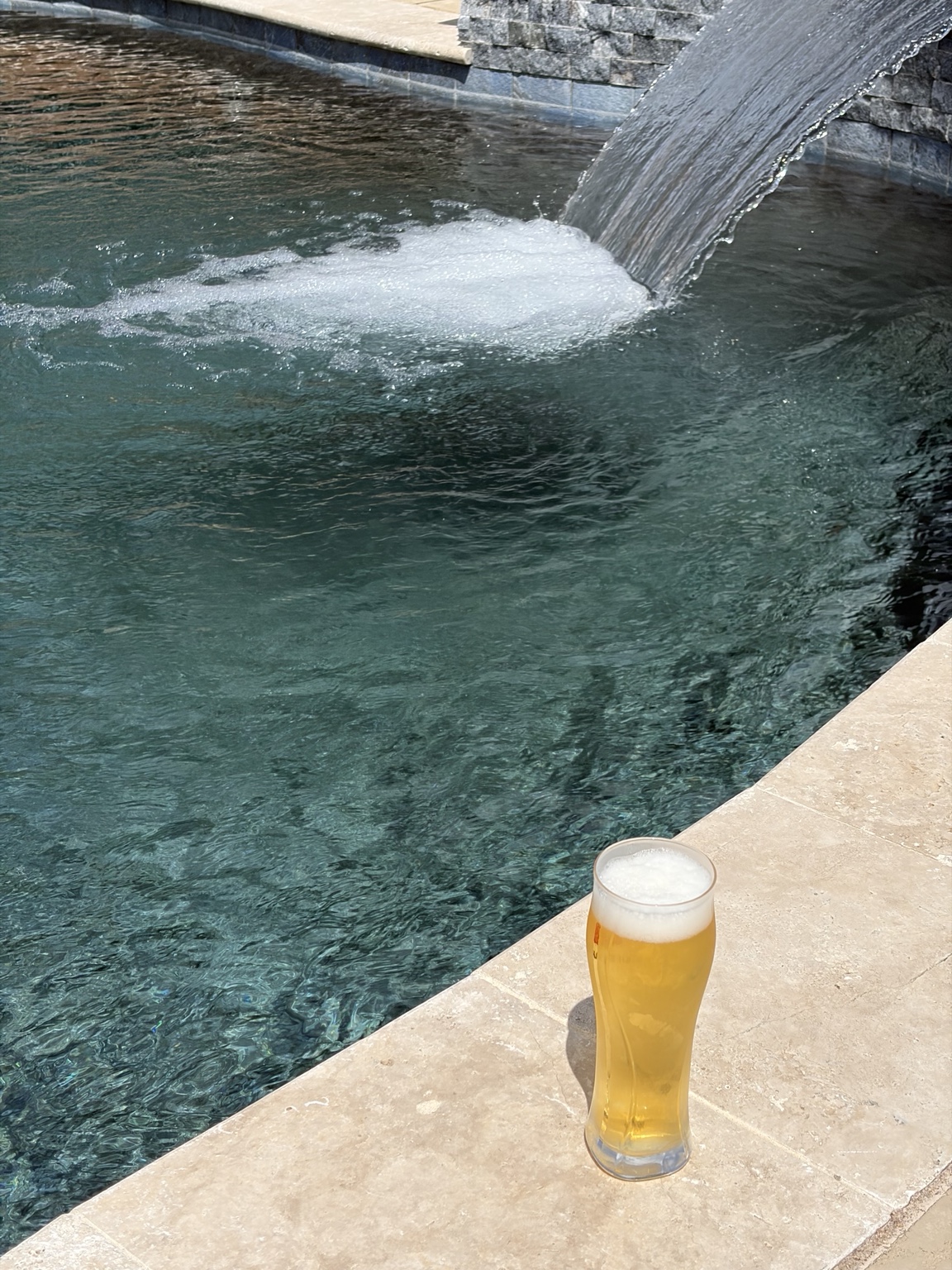
The result at a glance: 16,000 gallons
| Input / result | Value | How I treated it |
|---|---|---|
| Surface area | 42.62 m² (about 458.8 ft²) | Measured in Google Earth |
| Shallow-end depth | about 3 ft | Measured |
| Deep-end depth | about 6 ft | Measured |
| Average depth | 4.5 ft | Simplified model from the two measured endpoints |
| Pool body | about 15,443 gal | Calculated |
| Spa | about 529 gal (about 2,002 L) | Estimated from measured dimensions with a concentric-circle model |
| Total | about 15,972 gal | Pool body + spa |
| Working volume | 16,000 gal (about 60,600 L) | Used for chemicals, circulation, and cooling calculations with several-hundred-gallon uncertainty in mind |
Why I needed a pool-volume number
A pool can be managed loosely by feel in some situations. But as soon as I want to calculate chemical additions, pump turnover, or the heat represented by a water-temperature change, I need the total water volume as the denominator.
Research → measure → calculate → look at the uncertainty → choose a useful number.
Step 1: measure surface area in Google Earth
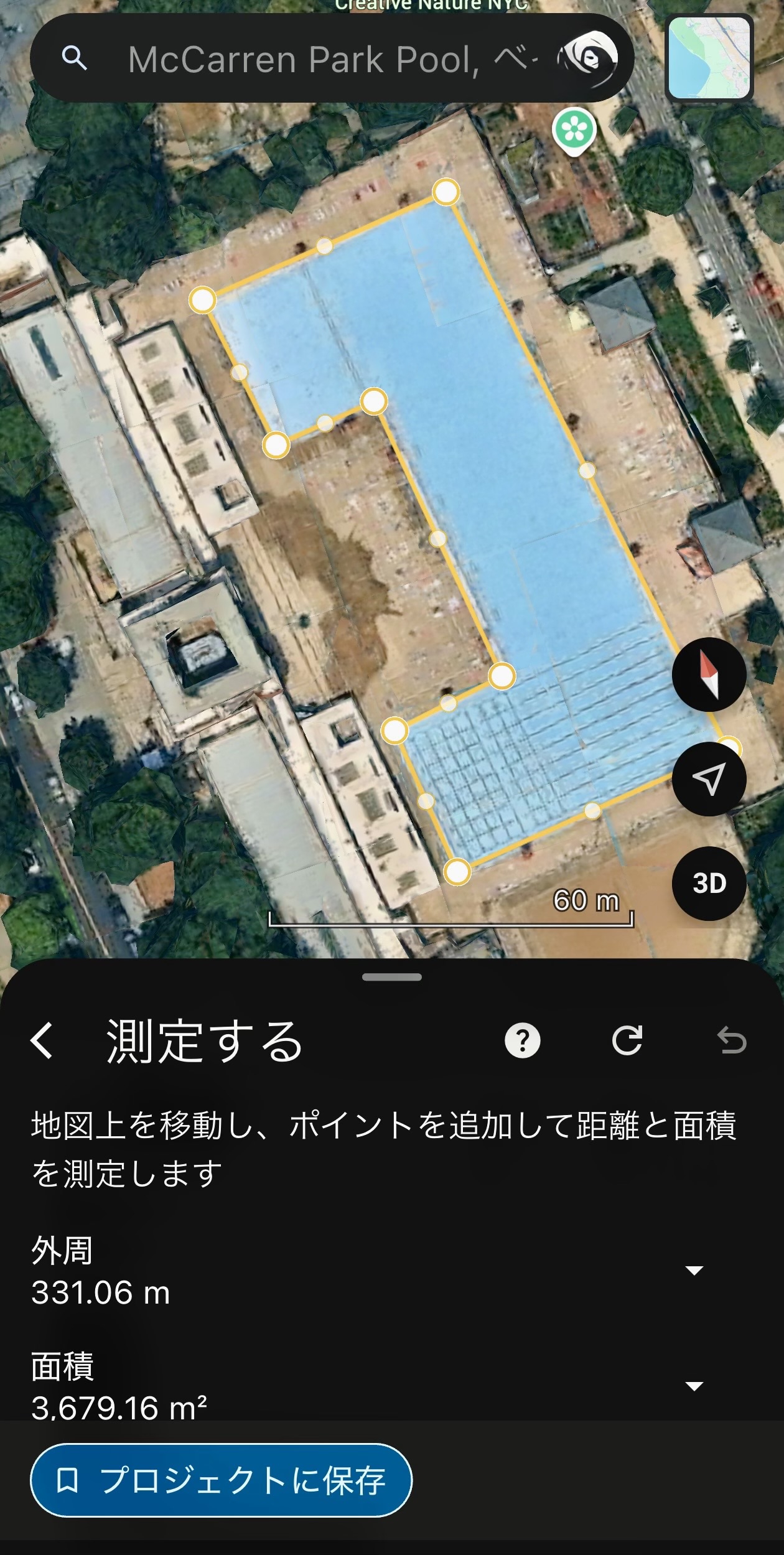
I traced the outline of my pool in Google Earth and measured a water-surface area of 42.62 m², or about 458.8 ft².
Google Earth can measure the area of a polygon drawn on the map. Google also notes that measurements may not be 100% accurate and recommends a top-down view for better results.[1]
Step 2: the shallow and deep depths were measured at the pool
The depth values did not come from Google Earth. I measured the pool itself: the shallow side is about 3 ft, and the deep side is about 6 ft.
For a simple volume estimate, I used the midpoint, 4.5 ft, as the average depth. That 4.5 ft number is not a direct measurement; it is a simplifying assumption built from the two measured endpoints.
The shallow and deep sections do not necessarily occupy equal surface area, and the floor slopes between them. So 4.5 ft is a practical approximation, not a detailed integration of the pool geometry.
Step 3: surface area × average depth
The arithmetic is straightforward:
458.8 ft² × 4.5 ft ≈ 2,064.4 ft³
2,064.4 ft³ × 7.480519 gal/ft³ ≈ 15,443 gal
NIST lists 1 cubic foot = 7.480519 U.S. gallons in its general unit-conversion tables.[2]
Step 4: estimate the spa separately — about 529 gallons
I treated the spa separately using dimensions I measured at the spa. Its inside diameter is about 2.0 m, so the outer radius is 1.0 m. A shallow bench runs around the outside and is about 0.40 m wide, leaving a central deep section with a radius of about 0.60 m. Water depth is about 0.45 m over the bench and about 0.97 m in the center.
Center: π × 0.6² × 0.97 ≈ 1.097 m³
Total ≈ 2.002 m³ ≈ 2,002 L ≈ 529 U.S. gal
The spa is not a perfect pair of concentric cylinders, so this is still a simplified geometric model. The advantage is that the estimate is now tied directly to measured diameter, bench width, and water depths.
Calculated separately, the total is about 15,972 gallons
Spa: about 529 gal
Total: about 15,972 gal
This is the part I like most: the pool body and spa were estimated separately, and their sum lands at about 15,972 gallons—almost exactly 16,000 gallons.
That does not mean 15,972 gallons is exact. The Google Earth outline has measurement uncertainty, 4.5 ft is a simplified pool-average depth built from the measured 3 ft and 6 ft endpoints, and the spa uses a concentric-circle model rather than its exact curved geometry.
Depth matters a lot. Keeping the same surface area and changing only the assumed average depth by 0.1 ft gives:
| Assumed average depth | Calculated pool-body volume | Difference from 4.5 ft |
|---|---|---|
| 4.4 ft | about 15,100 gal | about −343 gal |
| 4.5 ft | about 15,443 gal | baseline |
| 4.6 ft | about 15,786 gal | about +343 gal |
Just 0.1 ft (about 3 cm) changes the estimate by roughly 340 gallons. So even though the combined calculation comes to about 15,972 gallons, I should not treat the actual water volume as exactly 16,000 gallons. The floor slope, the relative areas of the shallow and deep sections, water level, and the simplified spa geometry can all move the result. I will use 16,000 gallons (about 60,600 L) as a common working baseline, while assuming the true volume may differ by several hundred gallons when interpreting chemical dosing, turnover, and cooling calculations.
What the 16,000-gallon baseline is for
The volume itself is not the end goal. It gives every later pool calculation the same reference point.
Unless I state otherwise, future Cony DIY Houston pool calculations will use 16,000 gallons as the working volume. It is a comparison and calculation baseline, not a precisely established volume, so I will allow for several hundred gallons of uncertainty.
Bottom line
I measured 42.62 m² of surface area in Google Earth and about 3 ft / 6 ft at the shallow and deep ends. Using 4.5 ft as a simplified average gives about 15,443 gallons for the pool body. Estimating the spa separately from its measured diameter, bench width, and two water depths gives about 529 gallons, for a combined total of about 15,972 gallons.
The pool-average depth and spa geometry are still simplified, and changing the assumed average depth by only 0.1 ft moves the estimate by about 340 gallons. I will therefore use 16,000 gallons (about 60,600 L) as a common working baseline for future chemical, circulation, and cooling calculations, while treating the actual volume as an approximation that may differ by several hundred gallons.
Research. Try. Measure. Compare. Learn.
References
- Google Earth Help, Measure distances and areas in Google Earth — iPhone & iPad. Polygon-area measurement and accuracy notes. Official help
- NIST Handbook 44, Appendix C, General Tables of Units of Measurement. Conversion factor of 1 ft³ = 7.480519 U.S. gal. Official publication
The Google Earth screenshot uses a different public pool to demonstrate the method without exposing my home location. The volume in this article is a working estimate based on surface area and measured endpoint depths, not an as-built construction volume or a metered fill measurement.
Questions or comments about this article?
If you are estimating your own pool volume, using Google Earth for surface area, or trying to connect volume to turnover and chemical dosing, feel free to ask.
The website keeps the calculation and conclusion organized. On X I also post the measurement process and how I use the number in actual pool maintenance.