
Does a Pool Cooler Actually Work? Measuring Evaporative Cooling in a 16,000-Gallon Pool
The Amazon listing said “10–20°F Cooler Water.” I wanted to know what the fountain was actually doing in my 16,000-gallon backyard pool, so I measured flow and water temperature, then worked backward through jet speed, flight time, and a deliberately simple evaporation model.
Results first
- Total spray flow was 18 L/min (4.8 gpm). Pool water was 32.8°C (91.0°F), while the stream measured 32.5°C (90.5°F) just before landing: a 0.30°C (0.54°F) drop per pass.
- Using that single retained temperature-difference measurement with the measured flow gives an order-of-magnitude estimate of about 380 W.
- If that 380 W estimate held continuously for 8 hours, it would correspond to only about 0.043°C (0.08°F) across a 16,000-gallon pool.
- With 46 holes at roughly 2 mm diameter and an estimated 75° launch angle, the calculated jet speed is about 2.08 m/s and flight time about 0.4–0.5 s.
- A highly simplified evaporation sanity check predicts roughly 0.23–0.28°C of cooling per pass—same order as the measured 0.30°C.
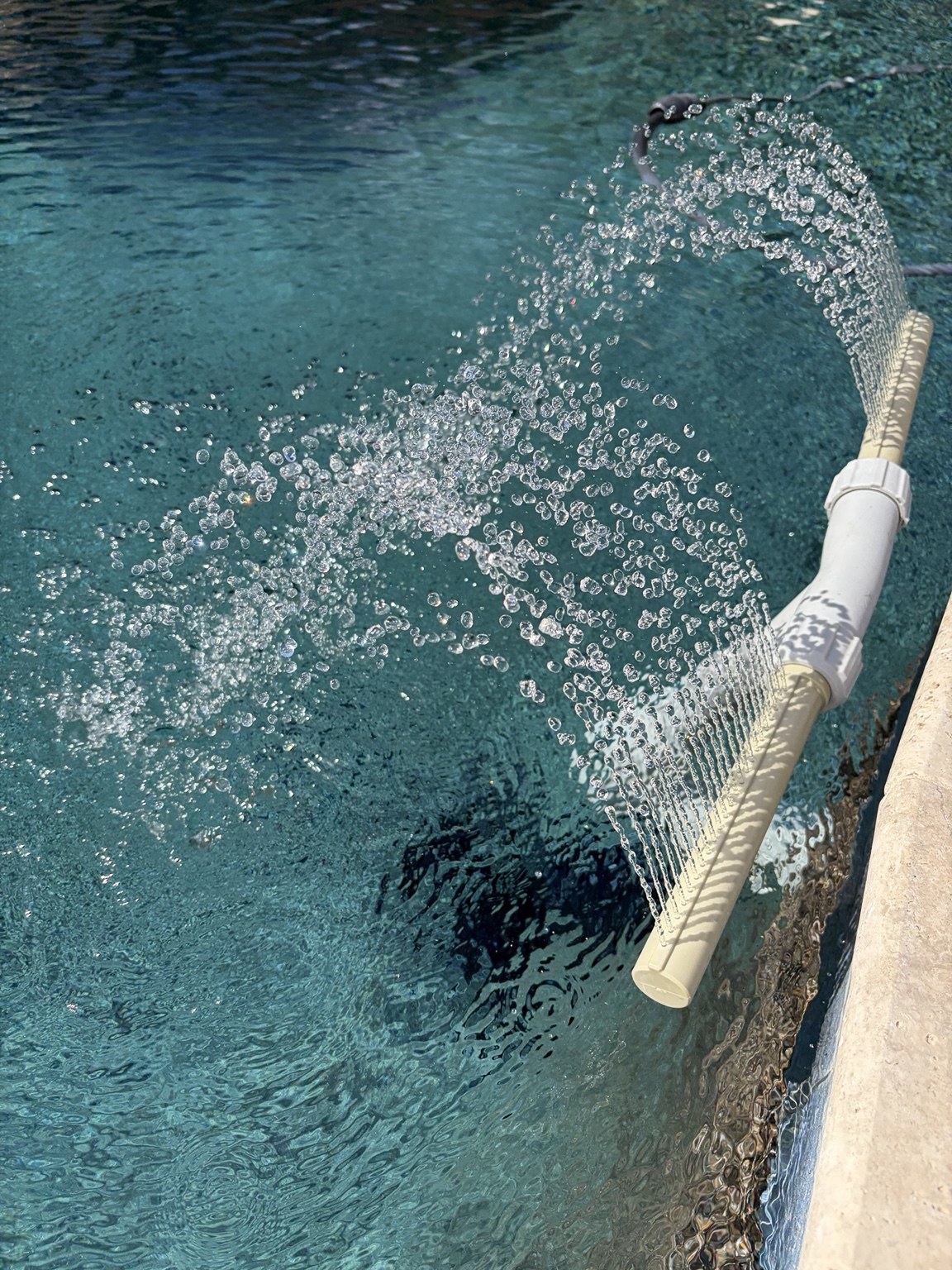
The question: what does “10–20°F cooler water” mean in practice?
When summer pool water gets hot, a fountain-style cooler is an appealingly simple idea: send return water into the air, expose more surface area, and let evaporation remove heat.
The product listing I bought used the phrase “10–20°F Cooler Water.” That number is difficult to interpret without a pool size, weather, runtime, and a definition of whether it refers to the airborne stream or the entire pool. Rather than trying to rule on the marketing language, I focused on a measurable question: how many watts of heat was this unit actually removing in my 16,000-gallon pool?
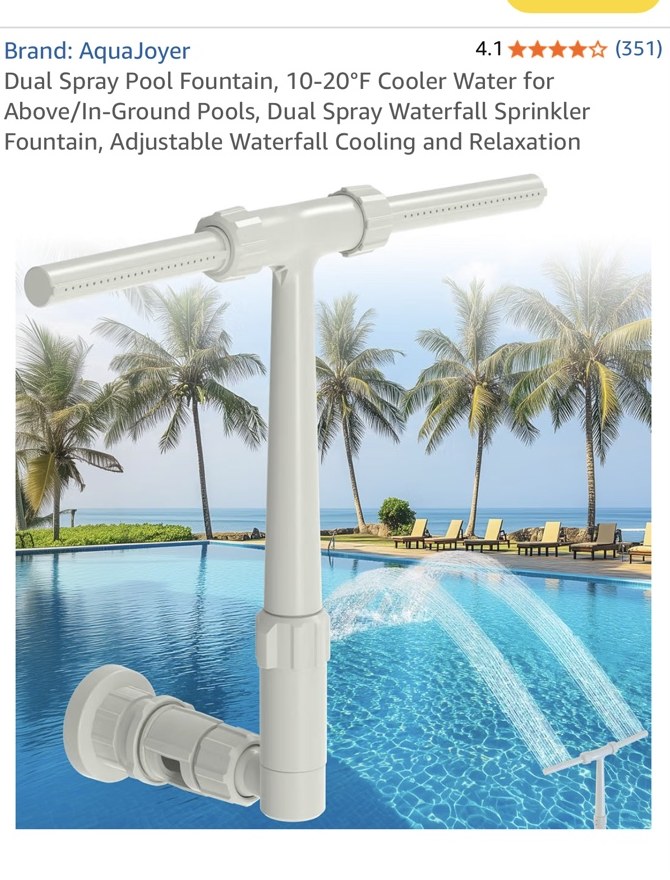
This is the Amazon product I used for the measurements in this article.
Measured first: the airborne stream cooled by 0.30°C
| Item | Measured / assumed value |
|---|---|
| Pool volume | 16,000 US gal (about 60,600 L) |
| Spray flow | 3 L / 10 s = 18 L/min (4.8 gpm) |
| Pool-water temperature | 32.8°C (91.0°F) |
| Water just before landing | 32.5°C (90.5°F) |
| Per-pass temperature drop | 0.30°C (0.54°F) |
| Ambient air during the test | about 32°C (90°F) |
I measured flow by collecting 3 L in 10 seconds. The water started at 32.8°C and measured 32.5°C immediately before it returned to the pool.
Record note: I later lost the temperature-measurement photos, so the temperatures here come from my notes from the test. The spray photos and video are still available.
Converting the single 0.30°C reading gives about 380 W
At 18 L/min, the mass flow is about 0.30 kg/s. Using water's specific heat near this temperature, about 4.19 kJ/(kg·°C)[4], the measured heat-removal rate is:
This 380 W figure is not a calibrated performance rating. It is an order-of-magnitude estimate from one retained 0.30°C temperature-difference measurement. Thermometer resolution, measurement position, and the lack of repeated trials all add uncertainty.
Even so, the estimate is consistent with the device removing some heat. The bigger problem is the thermal mass of a 16,000-gallon pool.
A 16,000-gallon pool holds roughly 60,600 kg of water. Dropping that by 1°C takes about 70.5 kWh.
If the roughly 380 W estimate held continuously for eight hours, the fountain would remove about 3.0 kWh. Spread across the entire pool, that corresponds to only about 0.043°C (0.08°F).
The measured 0.30°C is the drop across one airborne pass. It is not a 0.30°C drop in the entire pool.
The 16,000-gallon working volume comes from a separate measurement using Google Earth surface area plus measured water depth. Read the pool-volume calculation →
Can physics explain the 0.30°C per-pass drop?
Next I checked whether the measured stream cooling was physically reasonable. I counted 46 outlet holes. Their diameter is roughly 2 mm, and the visible launch angle is about 75° above horizontal.
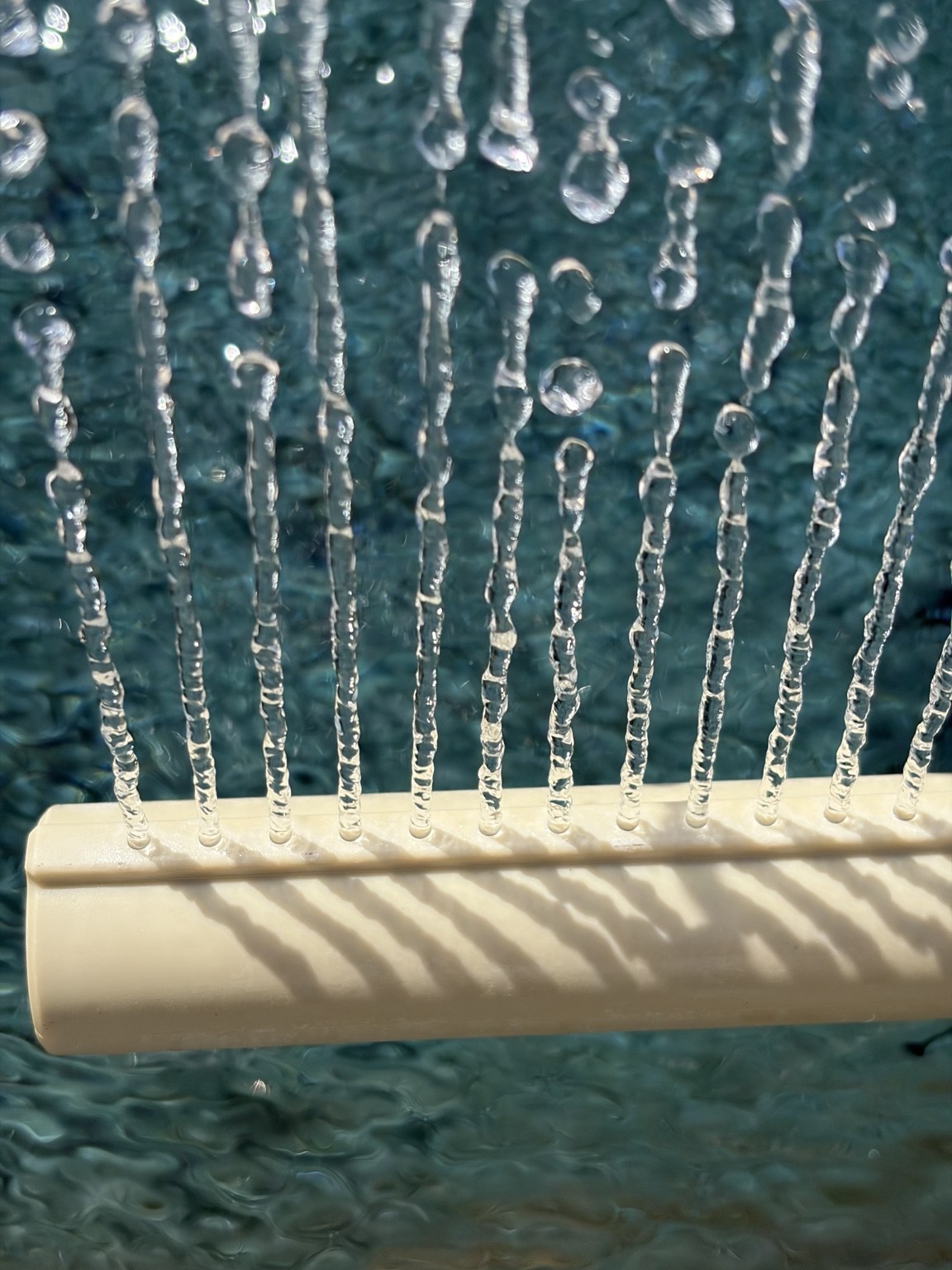
Jet velocity from 46 holes and measured flow
A 2 mm circular hole has an area of π×(0.001 m)². For 46 holes, the total open area is about 1.45×10⁻⁴ m².
So a useful first approximation is a roughly 2 mm jet leaving at about 2.1 m/s.
At 75°, flight time is roughly 0.4–0.5 seconds
Ignoring aerodynamic drag, ordinary projectile equations resolve launch velocity into vertical and horizontal components and use gravity to calculate flight time and maximum height[1].
If the water returned to exactly the nozzle height, total flight time would be about 0.41 s. In the real installation, the pool surface is roughly 10–20 cm below the nozzle, extending the calculated flight to about 0.45–0.49 s. Maximum rise is about 21 cm above the nozzle, which is reasonably consistent with the visible arc.
A deliberately simple evaporation sanity check
From this point on, the calculation is a model, not a direct measurement. The goal is not to predict 0.30°C exactly. It is to see whether evaporation over this diameter and flight time can plausibly produce cooling in the same range.
The 50% RH value is a modeling assumption, not a humidity measurement from that test. I used a water-vapor diffusion coefficient near room temperature of about 2.7×10⁻⁵ m²/s[3], a 2 mm characteristic diameter, and Sh≈2 as a deliberately simple diffusion-based baseline.
Using NIST saturation-vapor-pressure data[2], the vapor-concentration difference between 32.8°C water and 32°C / 50% RH air is about 0.018 kg/m³. I then estimated the evaporation flux J as the mass-transfer coefficient kₘ multiplied by the vapor-density difference Δρᵥ.
A long 2 mm cylinder has about 2 m² of surface area per kilogram of water. Over 0.41–0.49 s of flight, the model gives an evaporated mass fraction of only about 0.04–0.05%.
About Sh≈2: this is not a validated correlation for this exact continuous, deforming jet. Real wind, surface waves, jet breakup, and relative air speed all matter. I also do not model the small sensible-heat transfer caused by the 0.8°C water-to-air temperature difference as a separate term. Conversely, droplet forced-convection correlations are not automatically valid for a continuous jet. I use this only as an order-of-magnitude check.
That tiny evaporated fraction can still cool by about 0.23–0.28°C
Water's latent heat of vaporization around this temperature is on the order of 2.4 MJ/kg[5]. With f as the evaporated mass fraction, Lv as latent heat, and Cp as specific heat:
Measured: 0.30°C. That is surprisingly close.
I do not treat the agreement as proof that every assumption is correct. Hole diameter and launch angle are approximate, the jet is not a perfect cylinder, and the thermometer has finite resolution. The useful conclusion is narrower: even this crude evaporation model lands in the same order of magnitude as the measured stream cooling.
What would a 10–20°F drop mean for the entire 16,000-gallon pool?
If the listing's 10–20°F figure were interpreted as a bulk-pool temperature drop, the required heat removal would be enormous:
| Whole-pool drop | Heat that must be removed, ignoring heat gain |
|---|---|
| 10°F (5.56°C) | about 392 kWh |
| 20°F (11.11°C) | about 783 kWh |
Those numbers ignore solar gain, warm air, the ground, and pump heat. They also do not tell us what the seller intended, because the listing did not give a pool volume, weather condition, runtime, or a precise definition of the 10–20°F figure in the screenshot I saved. So I am not using my test to make a legal or advertising judgment. I can only say that under my 16,000-gallon / 18 L/min conditions, the retained single-pass measurement implies cooling on the order of 380 W.
Night use helps, but it does not change the basic conclusion
I normally run this type of cooler at night. Cooler and drier air increases the evaporation potential, and if the air is colder than the pool, ordinary convection also helps. But the pool still stores about 70.5 kWh per degree Celsius. A few hundred watts can be useful background cooling, yet it cannot move a 16,000-gallon pool by several degrees quickly.
For modifications, total cooling watts matter more than degrees per droplet
Making the jets thinner increases surface area per unit mass. For a long cylindrical jet, A/m≈4/(ρd), so a smaller diameter helps evaporation.
But simply shrinking the same 46 holes from 2 mm to 1 mm cuts total opening area to one quarter. Under the same pump conditions, flow may fall substantially. A smaller stream may cool more per pass while moving less water per hour—leaving total cooling power unchanged or only slightly improved.
I need to measure both flow and per-pass temperature drop, then compare P = ṁ × Cp × ΔT. A modification only helps the pool if total watts of heat removal increase.
A promising next direction would be increasing effective surface area without killing flow or flight time—perhaps splitting jets into coarse droplets while still returning the water to the pool. Another option is to increase total flow itself. If per-pass ΔT does not collapse, P = ṁ × Cp × ΔT means more mass flow can increase total cooling watts.
But higher flow is not automatically economical. If it requires more pump speed or pressure, electrical input and pump load also rise. A design that removes more heat but needs the same or more additional electricity may not be a better practical solution. A future test should compare cooling watts removed versus pump watts consumed, not cooling watts alone.
More flow or finer jets can also increase water lost outside the pool in wind. For now, these remain design hypotheses rather than tested improvements.
Conclusion: it cools the stream, but the pool is huge
The retained measurement showed the spray cooling from 32.8°C to 32.5°C. Combining that 0.30°C drop with 18 L/min gives an order-of-magnitude estimate of about 380 W, not a calibrated performance rating.
But a 16,000-gallon pool needs about 70.5 kWh for every 1°C of temperature change. If the rough 380 W estimate held for eight hours, that would correspond to only about 0.04°C across the whole pool.
The jet geometry also makes sense: 46 roughly 2 mm holes imply about 2.08 m/s exit velocity, 0.4–0.5 s of flight, and a simplified evaporation model gives about 0.23–0.28°C of cooling—same order as the measured 0.30°C.
The water cools. The pool is simply much bigger than the cooler.
References
- NASA Glenn Research Center, Ballistic Flight Equations — velocity components, gravitational flight time, and maximum height.
- NIST Chemistry WebBook, Water — Antoine Equation Parameters — saturation vapor pressure.
- T. R. Marrero and E. A. Mason, NIST / Journal of Physical and Chemical Reference Data, Gaseous Diffusion Coefficients — reference data for binary gas diffusion.
- IAPWS, Properties of Liquid Water at 0.1 MPa — liquid-water thermophysical properties.
- IAPWS, Saturation Properties of Ordinary Water Substance — saturated liquid/vapor enthalpy and related properties.
Questions or comments about this article?
If you want to compare the evaporation model, flow measurement, or a pool-cooler modification, feel free to send a note.
The spray video, jet geometry, and calculation steps also appeared as the experiment developed on X.