
Used EV Prices Rose 9.8%. Was My Used Nissan ARIYA a Better Deal Than a Mazda CX-5?
Used EVs are not necessarily getting cheaper anymore. Their average US asking price rose 9.8% year over year. But what about our own 2023 Nissan ARIYA Platinum+ e-4ORCE, bought used for about $31,000 in September 2024? I compare it with a hypothetical used Mazda CX-5 purchase using my measured ARIYA efficiency, our previous CX-9 fuel-economy experience, reference resale values, and one important unknown: long-term battery life.
The short answer
| Used EV market | September 2026 average asking price: $32,533, up 9.8% YoY. This does not mean each individual EV gained 9.8% in value. [1] |
|---|---|
| My ARIYA | Bought used at roughly 9,000 miles in September 2024 for about $31,000. Now at 27,248 miles, or 18,248 miles since purchase. |
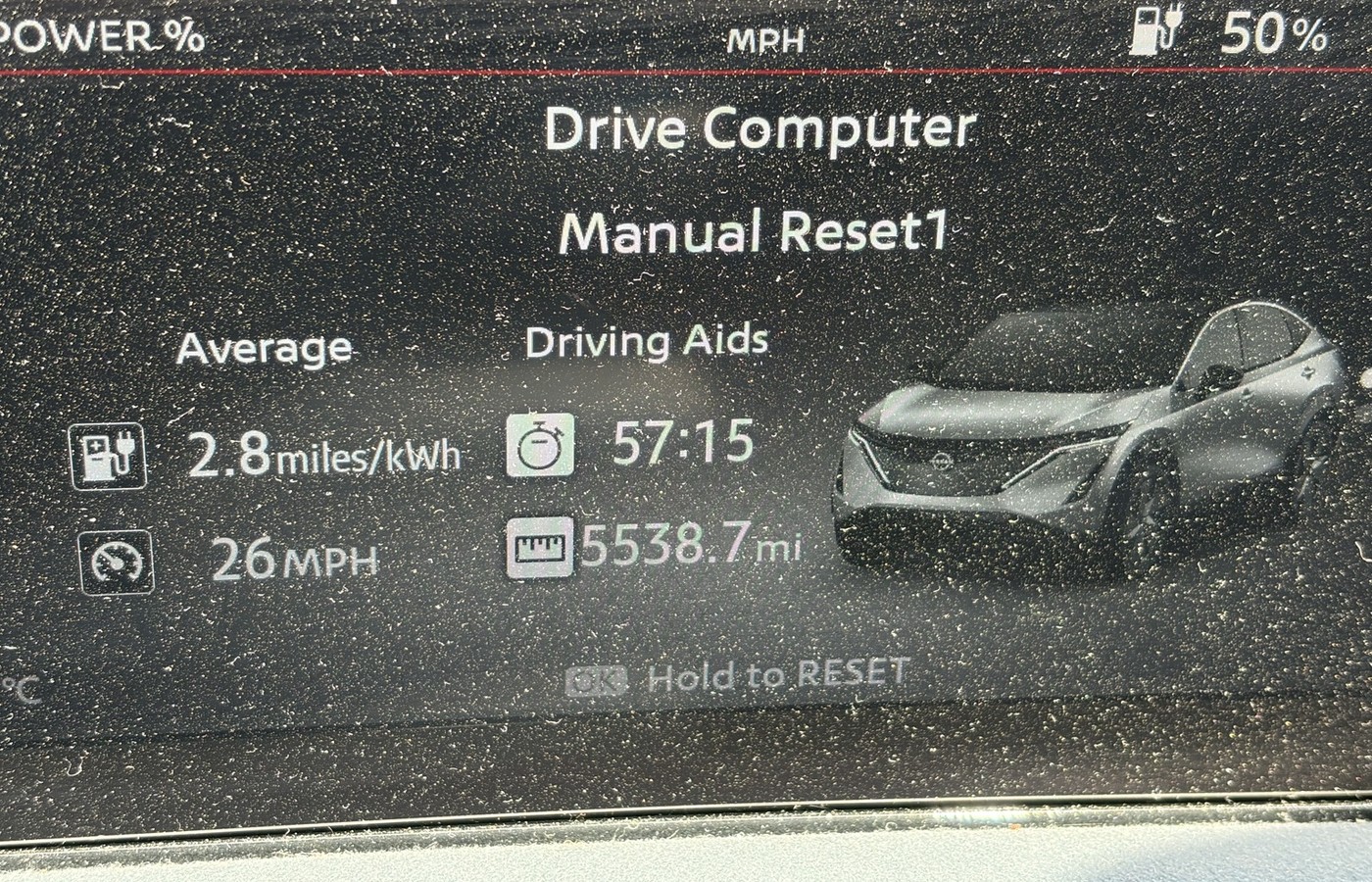
| Driving energy | ARIYA: measured 2.8 mi/kWh; modeled CX-5 Turbo: 16.8 mpg. Under our October 2026 price assumptions, the ARIYA costs about $2,821 less in driving energy. |
| With resale estimates | Selected ownership costs: ARIYA ~$7,552 vs CX-5 ~$10,531, a modeled ARIYA advantage of ~$2,979. Not a measured, comprehensive TCO comparison. |
| What happens next? | Battery health and future resale are key unknowns. Our dashboard still shows 12/12 capacity segments, but that is not proof of 100% SOH. |
1. Used EV prices really did turn upward
On October 28, 2026, iSeeCars published an analysis of more than 1.5 million one- to five-year-old used vehicles. Average September asking prices rose 9.8% for EVs, versus 4.9% for hybrids and 0.3% for gasoline vehicles. The average EV also sold nearly 13 days faster than a gas vehicle. [1]
| Powertrain | Sept. 2026 average asking price | YoY change | Days to sell |
|---|---|---|---|
| EV | $32,533 | +9.8% | 41.9 |
| Hybrid | $34,476 | +4.9% | 48.6 |
| Gas | $31,954 | +0.3% | 54.8 |
The EV series turned positive in April and stayed positive through September. iSeeCars points to higher gas prices and EV demand changes after federal incentive expiration as possible explanations. These are hypotheses, not a measured breakdown of causation. [1]
Model mix, vehicle ages, trims, inventory, and listed prices all matter. A 9.8% market increase does not mean our ARIYA appreciated by 9.8%.
2. Could better battery durability support used EV values?
This is an engineering interpretation, not a proven explanation for the 2026 rally. Better cells, active thermal management, and battery-management software could reduce buyer concerns about aging. But we cannot attribute any particular share of the +9.8% price gain to those advances.
Geotab analyzed more than 22,700 EVs across 21 models in 2026 and found average observed capacity degradation of 2.3% per year. Vehicles frequently using DC fast charging above 100 kW showed rates of up to about 3.0% annually versus around 1.5% for lower-power charging groups. Hot-climate vehicles experienced about 0.4 percentage points more annual degradation than mild-climate vehicles. These are observed associations across fleets, not a forecast for my specific ARIYA. [2]
Geotab's earlier 2024 figure was 1.8% annually, so it would be misleading to claim that reported degradation rates have improved every year; the sample and charging patterns also changed. Lower prices for newer EVs could simultaneously put downward pressure on older models.
3. What if I had bought a used 2023 CX-5 Turbo Signature in 2024?
Our actual car is a black 2023 Nissan ARIYA Platinum+ e-4ORCE AWD, bought used around September 2024 at roughly 9,000 miles for about $31,000. At the end of October 2026, the odometer reads 27,248 miles—18,248 miles driven during our ownership. The purchase amount is approximate, and it is not yet clear whether it included taxes and fees. The comparison assumes a used CX-5 purchase in 2024, not a new-car purchase. Its purchase price is modeled using the earlier KBB used-vehicle reference, not an actual transaction.
| Used-car comparison (2024) | ARIYA | CX-5 |
|---|---|---|
| 2023 trim | Platinum+ e-4ORCE AWD | 2.5 Turbo Signature AWD |
| Sept. 2024 used purchase / reference price | $31,000 actual (approx.) | $28,758 KBB used-value reference |
| Odometer at purchase | ~9,000 mi actual (approx.) | ~9,000 mi assumed for comparison |
| Oct. 2026 reference resale | $25,000 | $22,200 |
| Difference between buying and resale figures | $6,000 | $6,558 |
The CX-5's 2024 $28,758 was the annual modeled KBB resale reference adopted at the earlier research snapshot; KBB values vary by date and region. It is not a Houston September 2024 transaction average or a dealer retail purchase quote for a 9,000-mile example. The $25,000/$22,200 current values are representative estimates, not matched local appraisals. [4][5]
I am comparing what I paid for the used ARIYA, not its roughly $60,000 original new MSRP. The CX-5's hypothetical used-car purchase likewise starts from our selected 2024 KBB reference, not its original new price.
4. The Cony DIY part: measured driving versus an experience-based estimate
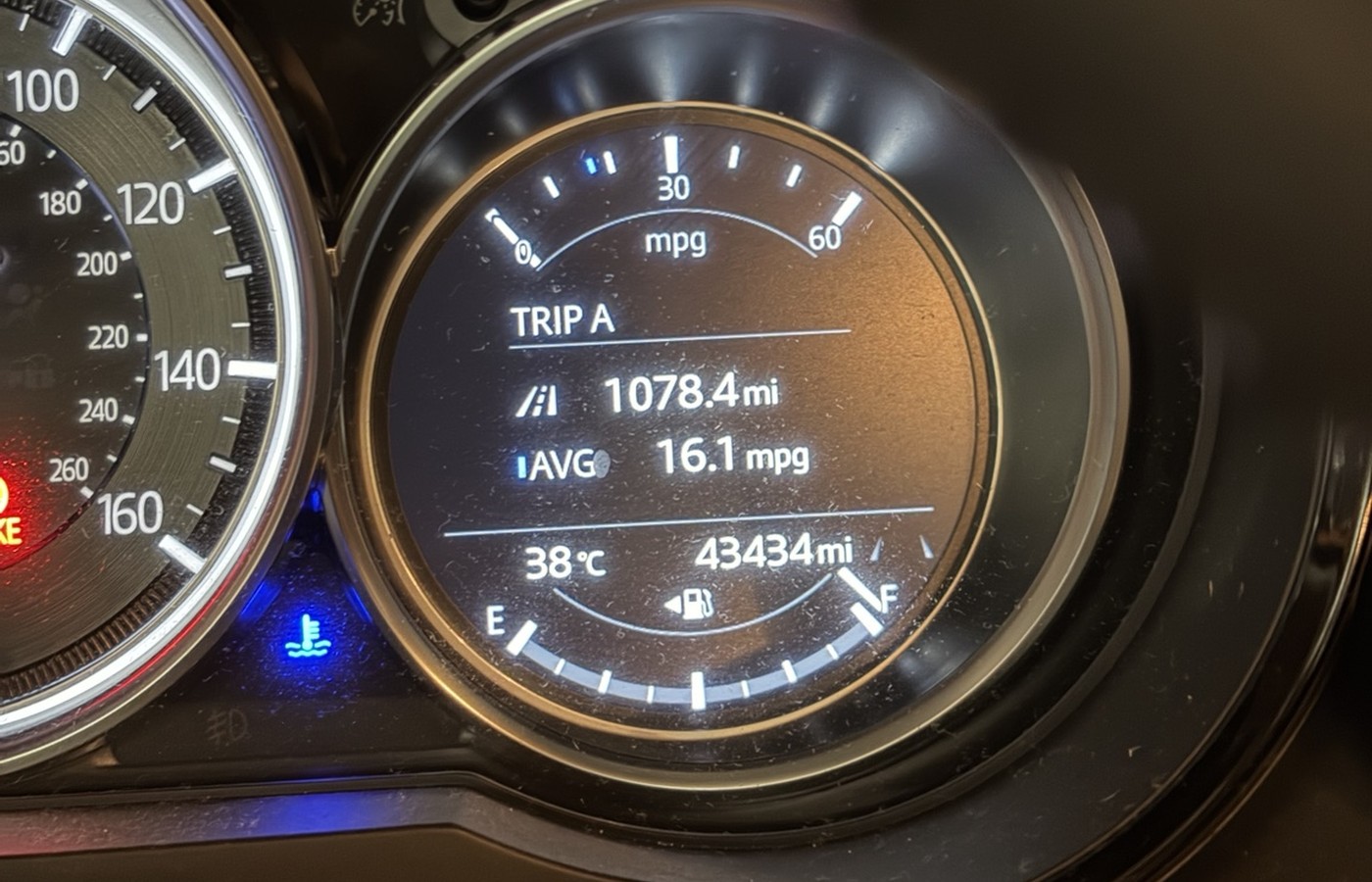
I wanted to go beyond a basic EPA comparison. In our earlier real-world cost test →, the ARIYA's computer showed 2.8 mi/kWh over about 5,539 miles. Our previous 2020 Mazda CX-9 AWD averaged 16.1 mpg over about 1,078 miles. The samples cover different cars and periods, not controlled back-to-back routes. [13]
The previous CX-9 returned 16.1 mpg versus a 23-mpg EPA combined figure, a factor of 16.1 / 23 = 0.70. Applying that same factor to a CX-5 Turbo Signature's 24-mpg EPA combined rating gives 24 × 0.70 = 16.8 mpg. Transferring the factor across vehicle models is only an approximation. [12][13]
For one consistent price snapshot, I use $3.658/gal for regular gasoline in Houston on October 30, 2026 (AAA), and $0.1591/kWh, the EIA's August 2026 Texas residential average—not our actual home utility rate. The dashboard's mi/kWh reading is treated as vehicle-side efficiency; I assume an additional 10% wall-to-car charging loss, not measured here. [7][8]
ARIYA wall energy = 18,248 ÷ 2.8 ÷ (1 − 0.10) ≈ 7,241 kWh
CX-5 gasoline = 18,248 ÷ 16.8 ≈ 1,086 gal
| For 18,248 miles | ARIYA | CX-5 Turbo |
|---|---|---|
| Measured / modeled efficiency | 2.8 mi/kWh measured over sample | 16.8 mpg modeled from CX-9 |
| Wall electricity / gasoline | ~7,241 kWh | ~1,086 gal |
| Driving energy cost | $1,152 | $3,973 |
| Difference | ~$2,821 in favor of ARIYA | |
This applies 2026 energy prices and one ARIYA sample efficiency reading across our entire 2024–2026 driving distance. These are not actual historical bills. Charging losses are assumed. Unlike a pure EPA comparison, both estimates use measured owner experience, although only the ARIYA was measured in that vehicle.
5. Add depreciation and Texas's extra EV registration fee
Texas charges an extra $200 per year to register an EV, in addition to ordinary registration costs. I allow $400 for two registration cycles as a comparison assumption; I have not checked actual receipts. [9]
| Selected 2024–2026 costs | ARIYA | CX-5 Turbo |
|---|---|---|
| Used purchase / 2024 reference | $31,000 | $28,758 |
| Reference resale today | −$25,000 | −$22,200 |
| Implied depreciation | $6,000 | $6,558 |
| Modeled driving energy | $1,152 | $3,973 |
| Extra Texas EV registration fee (assumed) | $400 | $0 |
| Total selected costs | $7,552 | $10,531 |
Including depreciation for both vehicles, the ARIYA actually loses about $558 less value in this illustrative reference-price setup, while using roughly $2,821 less energy. This is not money already received from selling the car.
This is not a complete TCO model. It excludes sales tax and dealer fees (possibly included in the ARIYA's recalled purchase amount), insurance, tires, maintenance, repairs, charging equipment, financing, opportunity cost, and selling costs. Neither vehicle has a matched Houston appraisal; a different resale figure could change the outcome.
Keeping all other assumptions unchanged, the baseline uses an ARIYA reference resale value of $25,000 and an estimated $2,979 cost advantage. If ARIYA resale were $24,000, the modeled advantage would be about $1,979; at $22,000, it would be about −$21 (a slight CX-5 advantage). These are hypothetical scenarios—not actual appraisals—showing how sensitive the comparison is to resale value.
6. Will the battery ultimately decide the long-term value?
Age, mileage, condition, accident history, and competing new-car prices matter for any used vehicle. But battery health is another substantial unknown for EVs because it affects useful range, buyer confidence, and repair risk.
Our ARIYA currently shows 12 out of 12 battery-capacity gauge segments. We have not measured actual SOH with a diagnostic tool, and 12/12 does not demonstrate zero degradation. Nissan's 2023 US warranty provides battery-related coverage generally for 8 years / 100,000 miles, with capacity-warranty repairs triggered when the gauge falls below nine segments, subject to its terms. [10]
7. Calendar aging: temperature, state of charge, and daily habits
Lithium-ion capacity loss can be discussed in terms of calendar aging—degradation even without cycling—and cycle aging caused by charge/discharge use. Storage temperature and state of charge (SOC) strongly influence calendar aging. Charging power, temperature, and cycling windows also influence degradation. For modest annual mileage and gentle cycling, calendar aging can be a major contribution, but its share varies by chemistry and use. [3]
| Potential stressor | Practical way to reduce it |
|---|---|
| Hot storage | Prefer shade or cooler parking where possible; Houston's ambient climate is not optional |
| Long periods at high SOC | Keep routine charge levels moderate while leaving enough range for daily needs |
| Frequent high-power DC charging | Use gentle home charging for routine needs; fast-charge for trips when necessary |
| Very low SOC for long periods | Avoid prolonged storage near empty, too |
My actual habits: DC fast charging is rare, routine charging almost never exceeds 80% SOC, and higher charging is mostly reserved for departures on longer trips. Houston heat is hard to avoid, but minimizing high temperature combined with high SOC over time is within reach. The 80% practice is my operating choice, not a universal chemistry-independent threshold.
I cannot quantify how much these practices have slowed my pack's aging. The observable record today is 12/12 segments. Long-duration calendar-aging research also finds strong dependence on temperature, SOC, and cell chemistry, making one-size-fits-all battery-life predictions unreliable. [3]
8. CATL cells, Nissan engineers, and the person charging the car
Nissan specifies a liquid-cooled and heated traction battery for the 2023 ARIYA; Platinum+ has 91 kWh gross, 87 kWh usable capacity. CATL has been named in reporting about ARIYA's cells, but Nissan's chief engineer declined to confirm the supplier in a published interview. We therefore do not claim to have verified the cell manufacturer of this particular car. [6][11]
Long-term performance is a combined outcome of cell chemistry and production quality × Nissan's thermal and battery-management controls × owner decisions about storage SOC, temperature, and charging.
9. Conclusion: the used-ARIYA experiment is not over
My 2024 used-ARIYA purchase looks favorable by about $2,979 against our modeled CX-5 Turbo under this particular set of reference prices and energy assumptions. That is an illustrative comparison, not a settled accounting result.
If the pack ages gracefully, buying after steep early depreciation and continuing to drive at low energy cost could become more rewarding. Unexpected degradation or an expensive post-warranty repair could reverse the result.
Nissan's battery engineers, the battery cell technology, and how I use the car in Houston. The final verdict on long-term ownership cost is still ahead. I will keep observing this ARIYA—currently at 12/12 segments—and keep testing the economics as the miles add up.
As-of dates: market prices September 2026 (iSeeCars published October 28); gasoline October 30, 2026; Texas electricity August 2026; vehicle mileage end of October 2026. KBB reference values may change. No confirmed sale or battery SOH test has occurred.
References
- iSeeCars, Used EVs Are Getting More Expensive While Selling Faster Than Gas Cars, 2026-10-28.
- Geotab, How Long Do Electric Car Batteries Last? Updated 22,700-EV analysis, 2026.
- Joule, A Decade of Insights: Delving into Calendar Aging Trends and Implications (2025).
- Kelley Blue Book, 2023 Mazda CX-5 2.5 Turbo Signature: values and annual depreciation.
- Kelley Blue Book, 2023 Nissan ARIYA Platinum+ e-4ORCE: values and depreciation.
- Nissan USA, 2023 Nissan ARIYA press kit: e-4ORCE specifications.
- AAA, Texas / Houston gasoline price averages (2026-10-30 snapshot).
- EIA, Electric Power Monthly, Table 5.6.A, August 2026 Texas residential electricity prices.
- TxDMV, Register Your Vehicle: $200 annual EV fee.
- Nissan USA, 2023 ARIYA Warranty Information Booklet: battery coverage and capacity gauge.
- EVsmart, Interview with Nissan chief engineer Hikaru Nakajima: battery supplier undisclosed.
- Edmunds, 2023 Mazda CX-5 2.5 Turbo Signature EPA combined 24 mpg.
- Cony DIY Houston, Earlier real-world Houston EV vs gas cost article.
Questions or comments about this comparison?
Have questions or real-world experience with used-EV pricing, ARIYA versus CX-5 running costs and resale values, battery degradation, or long-term ownership? I would love to hear them.
The starting point was our real-world ARIYA vs CX-9 fuel-cost test. Follow the next experiments and updates on X.