
Was Gas Really Below $2 in Houston? Ariya vs CX-9 EV Cost Comparison
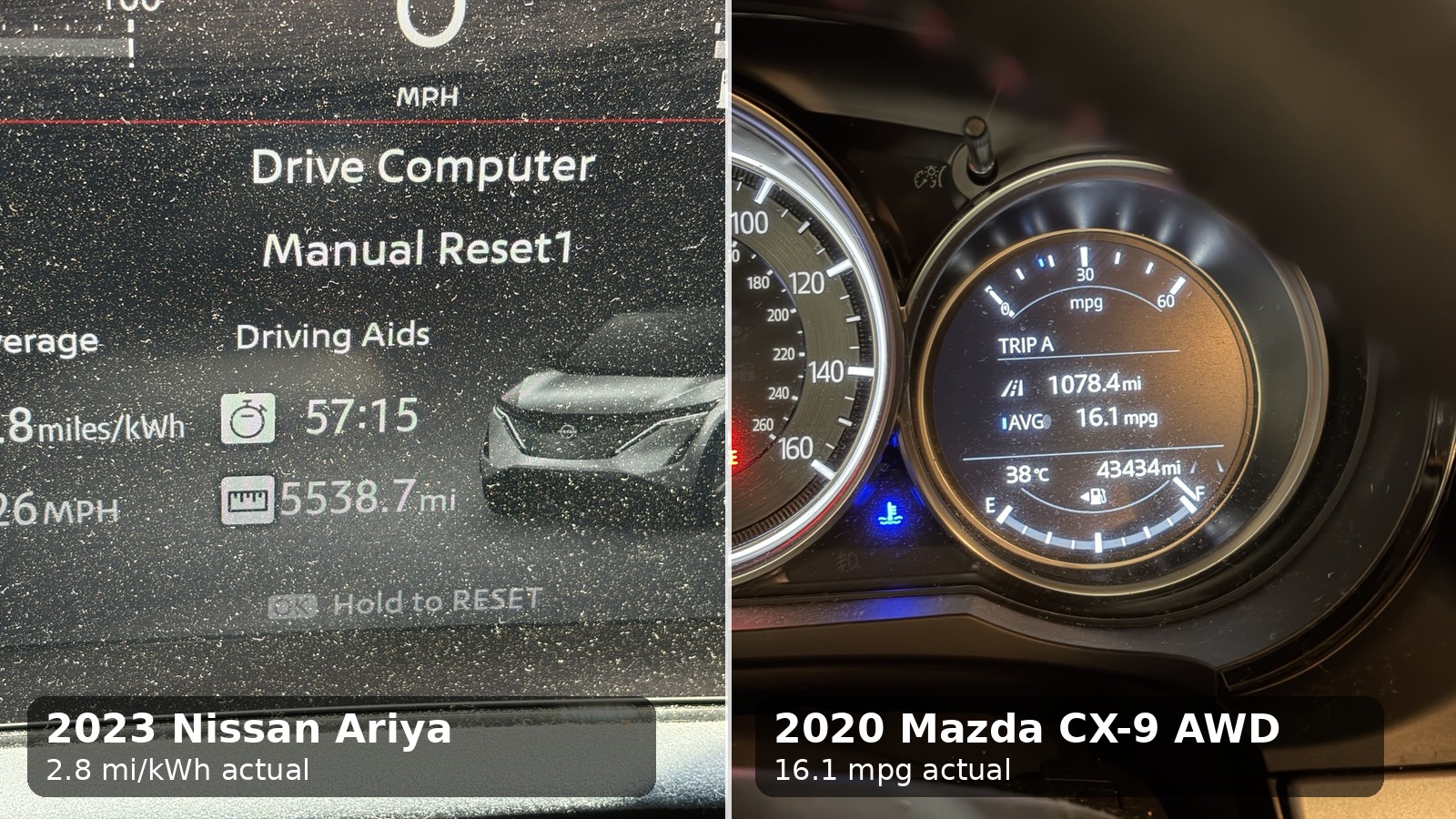
Looking at recent pump prices made me wonder: “Was Houston really around $2 a gallon at the beginning of 2026? I swear I even saw a $1.xx price.” I checked the historical data, and the memory was surprisingly accurate. Houston monthly averages were in the low $2s, and specific stations were documented at $1.90–$1.94/gal. Then I took the question one step further: if gasoline can be that cheap in Texas, does an EV still save money? I used our real-world 2023 Nissan Ariya at 2.8 mi/kWh and 2020 Mazda CX-9 AWD at 16.1 mpg to find out.
Bottom line first
| Was Houston gas really that cheap? | Yes. EIA's January 2026 Houston monthly average was $2.312/gal and February was $2.420. GasBuddy-based local reporting documented individual stations at $1.90 and $1.94. [1][5][6] |
|---|---|
| Our real-world vehicles | Ariya: 2.8 mi/kWh. CX-9 AWD: 16.1 mpg. I also built an 18.2 mpg CX-5 comparison model using the same real-world-vs-EPA penalty. [8][9] |
| Home charging | In the frozen September 22 price snapshot, the Ariya was $6.37/100 mi in Texas versus $21.77 for the modeled CX-5 and $24.61 for the measured CX-9. |
| DC fast charging | At a Houston 350 kW site listed at $0.64/kWh, the Ariya model reaches about $24.06/100 mi — almost the same as our CX-9. At a $0.35/kWh 60 kW example, it drops to about $13.16. [14][15] |
| Texas EV registration fee | Texas adds $200/year for a BEV. At 12,000 miles/year, the home-charging model still leaves about $1,648/year versus the modeled CX-5 and $1,988/year versus the measured CX-9. [16] |
| Biggest takeaway | The strongest cost advantage was not simply “EV vs gas.” It was cheap home charging. Expensive public DC fast charging can erase much of that advantage in Texas. |
1. Was Houston really around $2 per gallon?
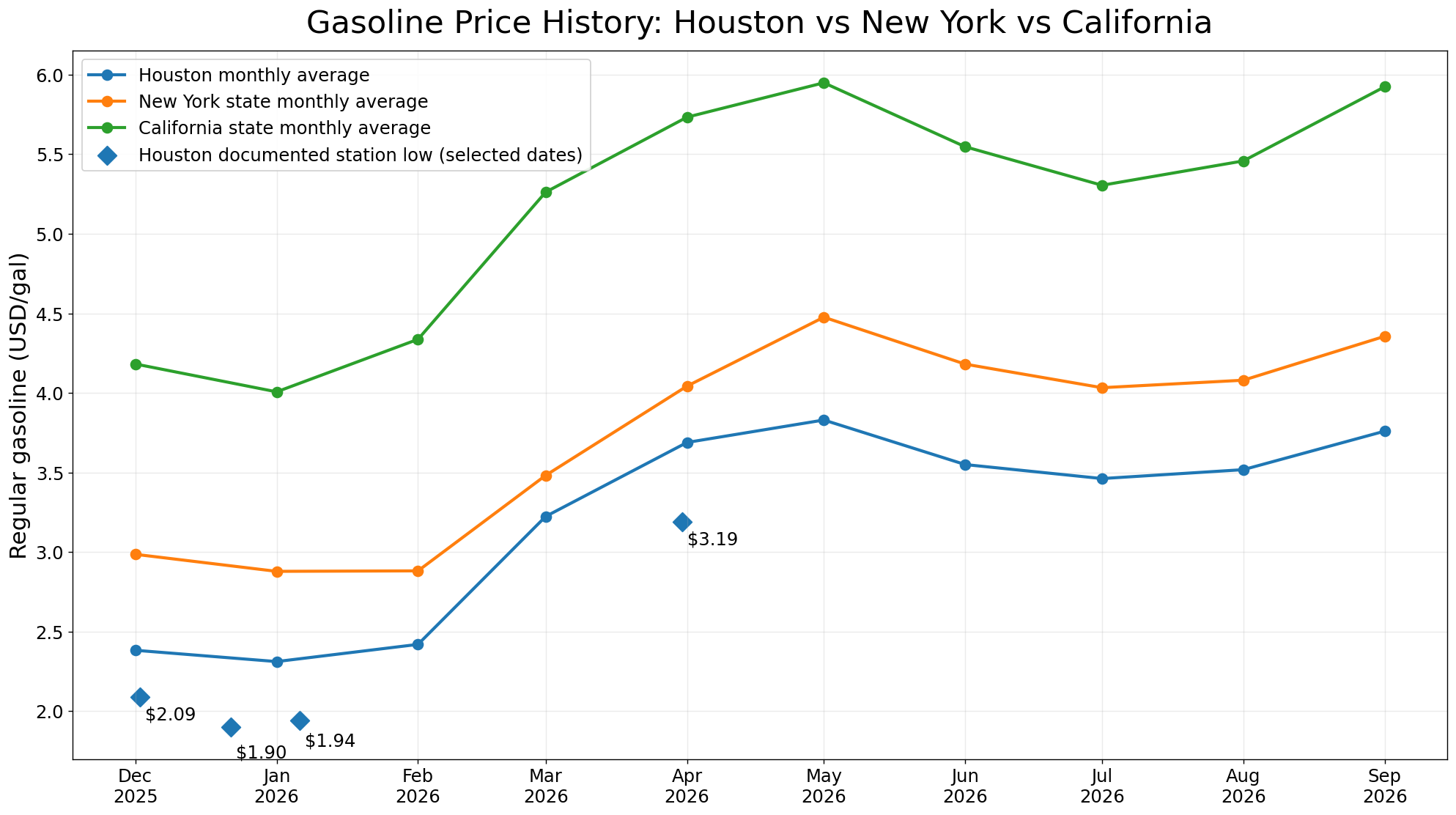
I started with the memory check. EIA's Houston regular-gas monthly average was $2.383/gal in December 2025, $2.312 in January 2026, and $2.420 in February. Then the market moved quickly: $3.224 in March, $3.689 in April, and $3.830 in May. It eased to $3.550 in June, $3.462 in July and $3.518 in August before climbing again to $3.760/gal in September. [1]
For context, I plotted New York and California state averages alongside Houston. The geography is not perfectly apples-to-apples — Houston is a metro-area series while New York and California are state averages — so I use the chart as a broad context comparison, not a strict ranking. [2][3]
2. The $1.xx memory was real — but it was not the city average
Houston Chronicle stories citing GasBuddy reported a $2.09 low on December 2, 2025, a $1.90 low on December 22, and $1.94 cash at Market At Beamer on January 6, 2026. [4][5][6]
$1.90 and $1.94 were individual station prices, not Houston averages. EIA's January 2026 Houston monthly average was $2.312/gal. [1]
By March 31, GasBuddy-based reporting put the Houston average near $3.55 with the lowest reported station at $3.19. The change happened in a matter of months, not years. [7]
3. If Texas gasoline is cheap, does the EV still win?
This is where our own cars come in. The 2023 Nissan Ariya and 2020 Mazda CX-9 AWD live the same basic family routine, including a lot of waiting during school pickup. I wanted the comparison to reflect that real use, not just EPA ratings.
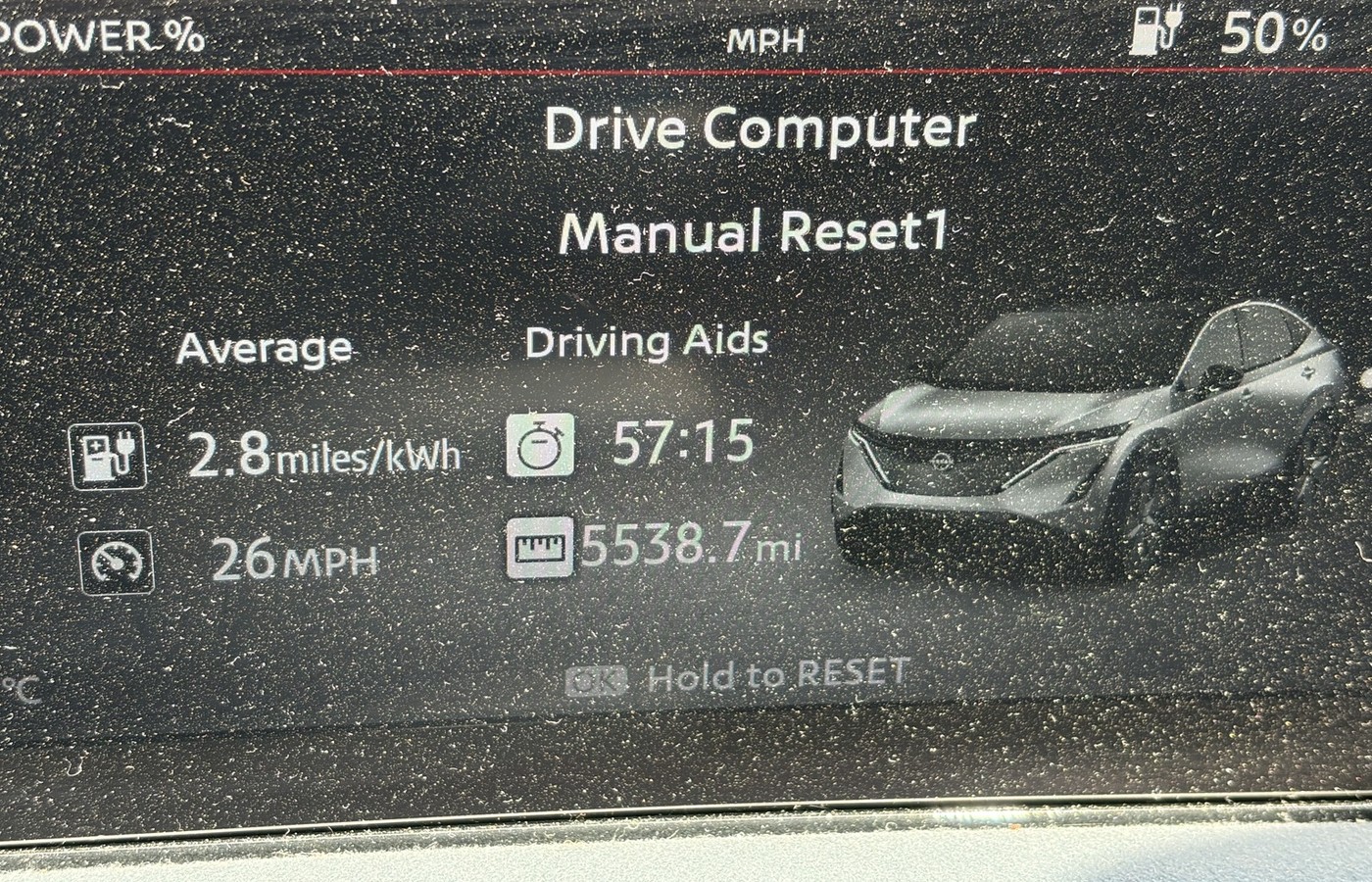
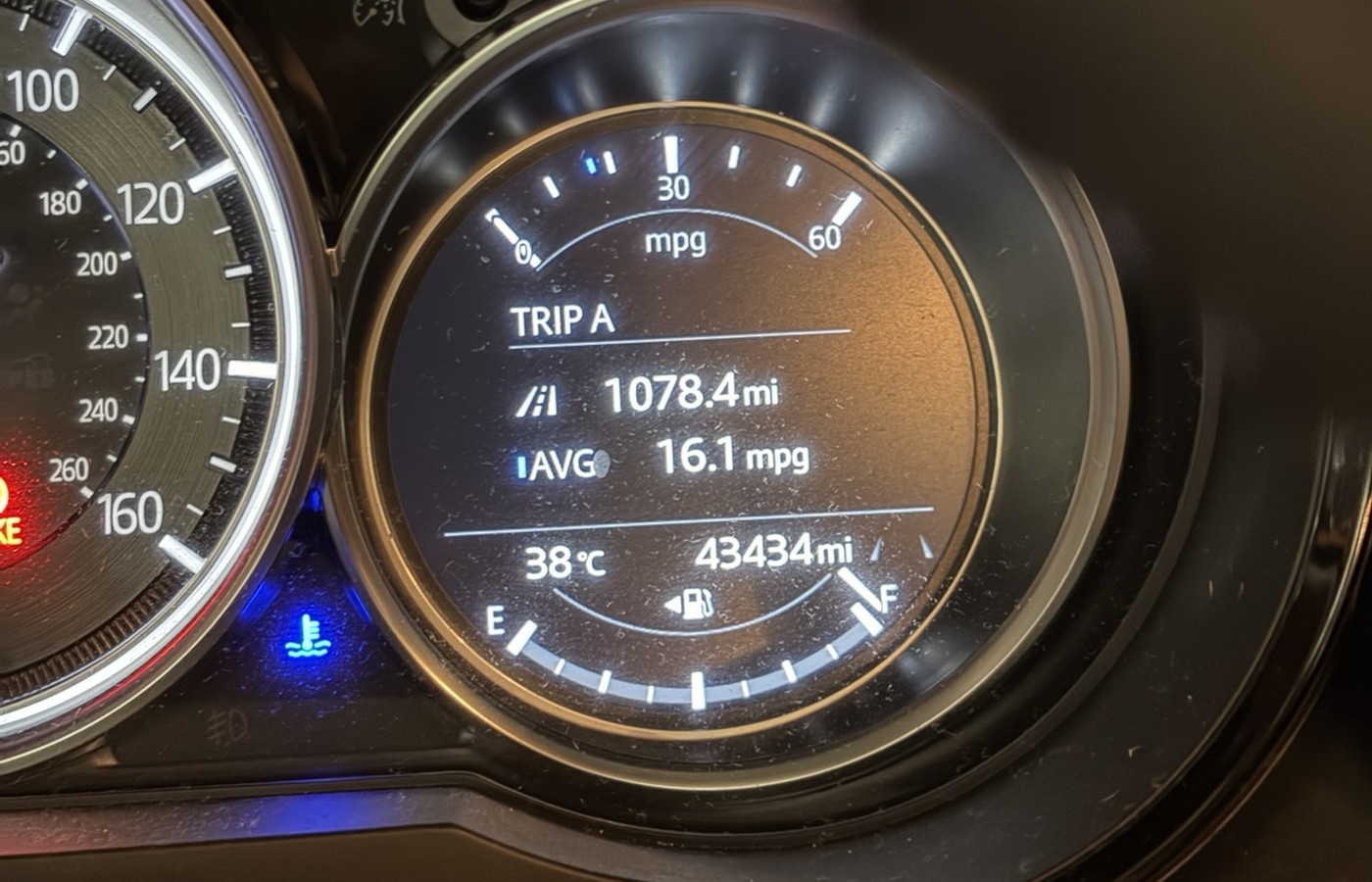
The Ariya and CX-9 dashboard averages are not a controlled A/B comparison over the same dates or the same mileage. They are real-world averages from the separate intervals that were stored on each vehicle.
Mazda lists the 2020 CX-9 AWD at 20 city / 26 highway mpg, or 23 mpg combined. Our 16.1 mpg is about 70% of that combined figure. [8] Because the CX-9 is larger than the Ariya, I also applied that same ~70% real-world penalty to a 2020 non-turbo CX-5 AWD, rated 24 city / 30 highway (26 combined), producing an 18.2 mpg modeled comparison. [9]
CX-9 actual/EPA = 16.1 ÷ 23 ≈ 0.70
Modeled CX-5 = 26 × 0.70 ≈ 18.2 mpg
The 18.2 mpg CX-5 figure is not measured data. It is only a size-fairness sensitivity model.
4. Texas vs. New York vs. California in $/100 miles
I froze this comparison at the price snapshot used when I built the X series on September 22, 2026. Gasoline is the AAA regular-gas state average I recorded that day; residential electricity is EIA's June 2026 state average, which was the latest published release at the time. [12][13]
The Ariya's 2.8 mi/kWh dashboard number is vehicle-side energy use. To estimate wall electricity, I needed a charging-loss assumption. I could not find a Nissan-published combined efficiency for this exact Ariya + portable EVSE setup, so I used the EPA MOVES reference model for a new EV: 94% charging efficiency × 95% battery efficiency = 89.3% wall-to-output. This is not a Nissan-specific rating. [11]
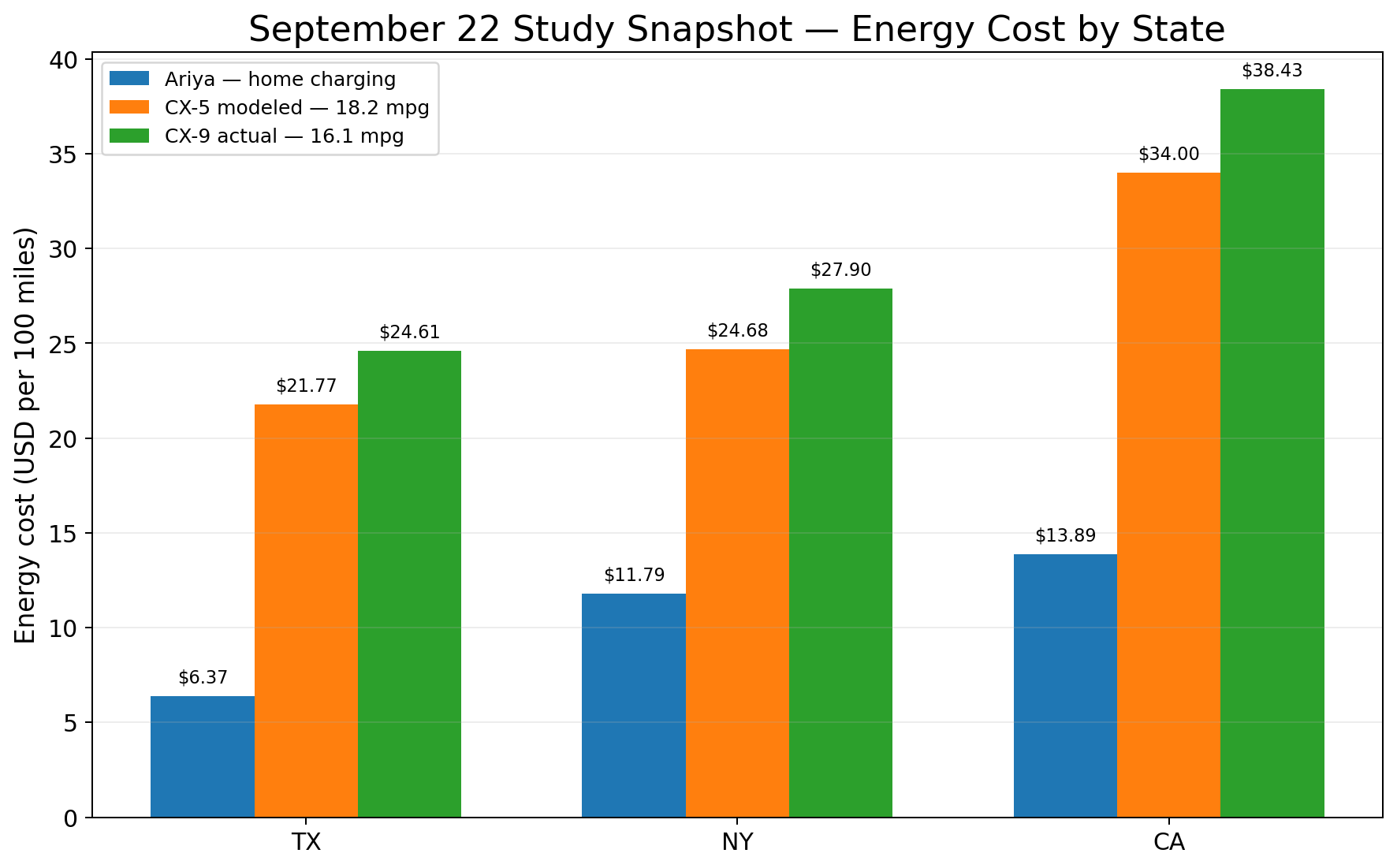
| State | Ariya home | Modeled CX-5, 18.2 mpg | Measured CX-9, 16.1 mpg |
|---|---|---|---|
| Texas | $6.37 | $21.77 | $24.61 |
| New York | $11.79 | $24.68 | $27.90 |
| California | $13.89 | $34.00 | $38.43 |
California electricity is expensive, but gasoline was even more expensive in the snapshot, so the home-charging spread is large. Texas is the tougher test for the EV because gasoline is relatively cheaper — and the Ariya still keeps a substantial home-charging advantage in this model.
5. What gasoline and electricity prices would flip the result?
Moving only gasoline while holding electricity constant felt incomplete, so I plotted both variables. The line is the break-even point against the modeled 18.2 mpg CX-5.
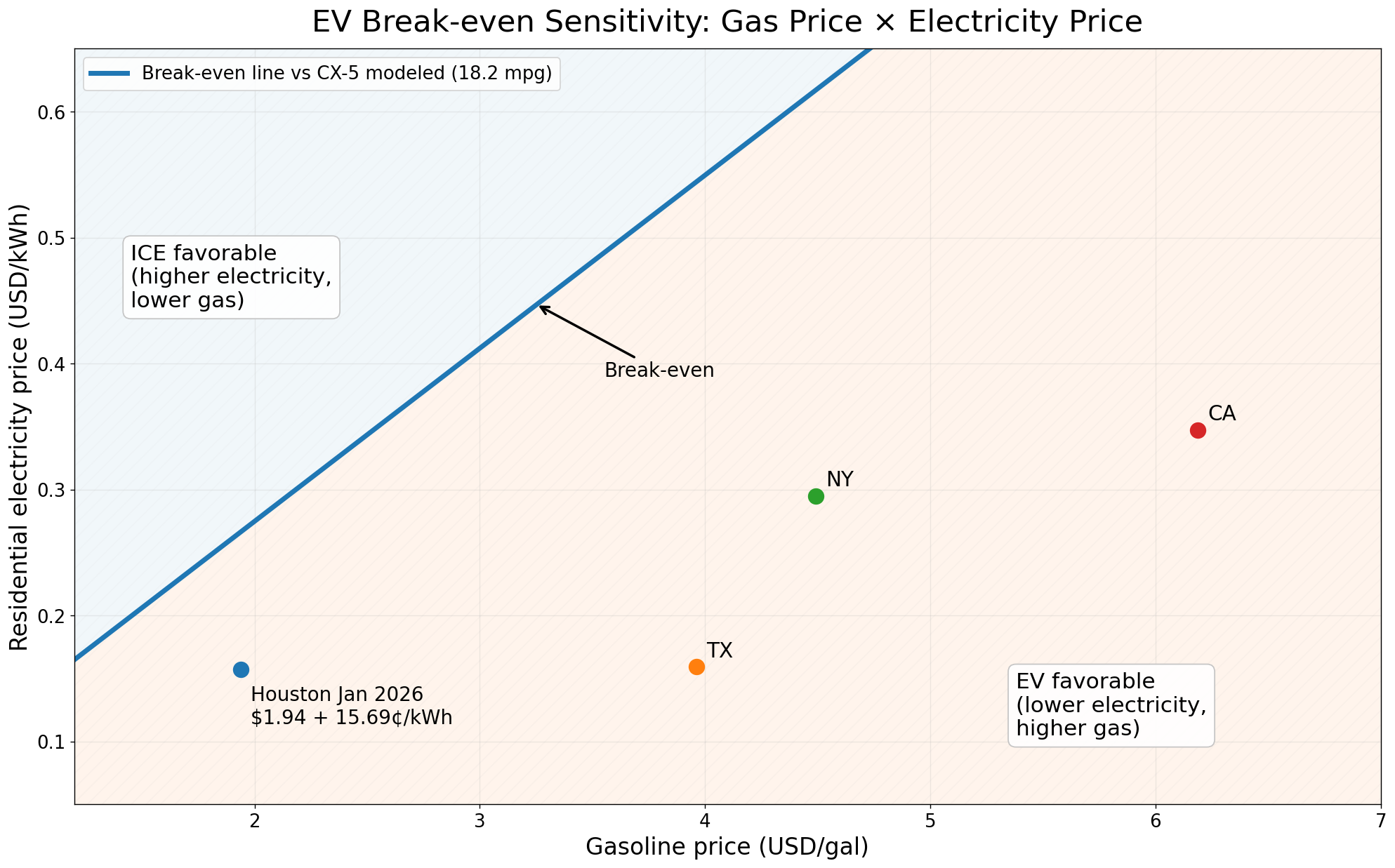
Even at the extreme $1.94/gal station price, pairing it with Texas' January 2026 residential electricity rate of 15.69¢/kWh gives the Ariya about $6.27/100 mi, versus $10.66 for the modeled CX-5 and $12.05 for our measured CX-9. [6] That does not mean every EV beats every gas car at $1.xx fuel — only that our measured/modelled combination still favored home charging.
The $1.94 input is a station-low stress test, not the Houston average. Actual household electricity costs also depend on plan structure, time-of-use pricing and how fixed charges are treated.
6. Then I switched to a 350 kW fast charger — and the advantage disappeared
Home charging made the EV look easy. Public DC fast charging changed the picture.
In the September 22 study snapshot, Electrify America's Walmart 5959 site in Houston was listed at up to 350 kW and $0.64/kWh. [14] Using the Ariya's measured 2.8 mi/kWh and a 5% DC-side loss purely as a sensitivity assumption gives about $24.06/100 mi. For the Houston gasoline side, I used EIA's closest weekly observation to September 22: $3.863/gal on September 21, 2026. That puts our measured 16.1 mpg CX-9 at about $23.99/100 mi and the modeled 18.2 mpg CX-5 at about $21.23/100 mi. The expensive DC-fast-charge Ariya and the CX-9 are essentially tied. [18]
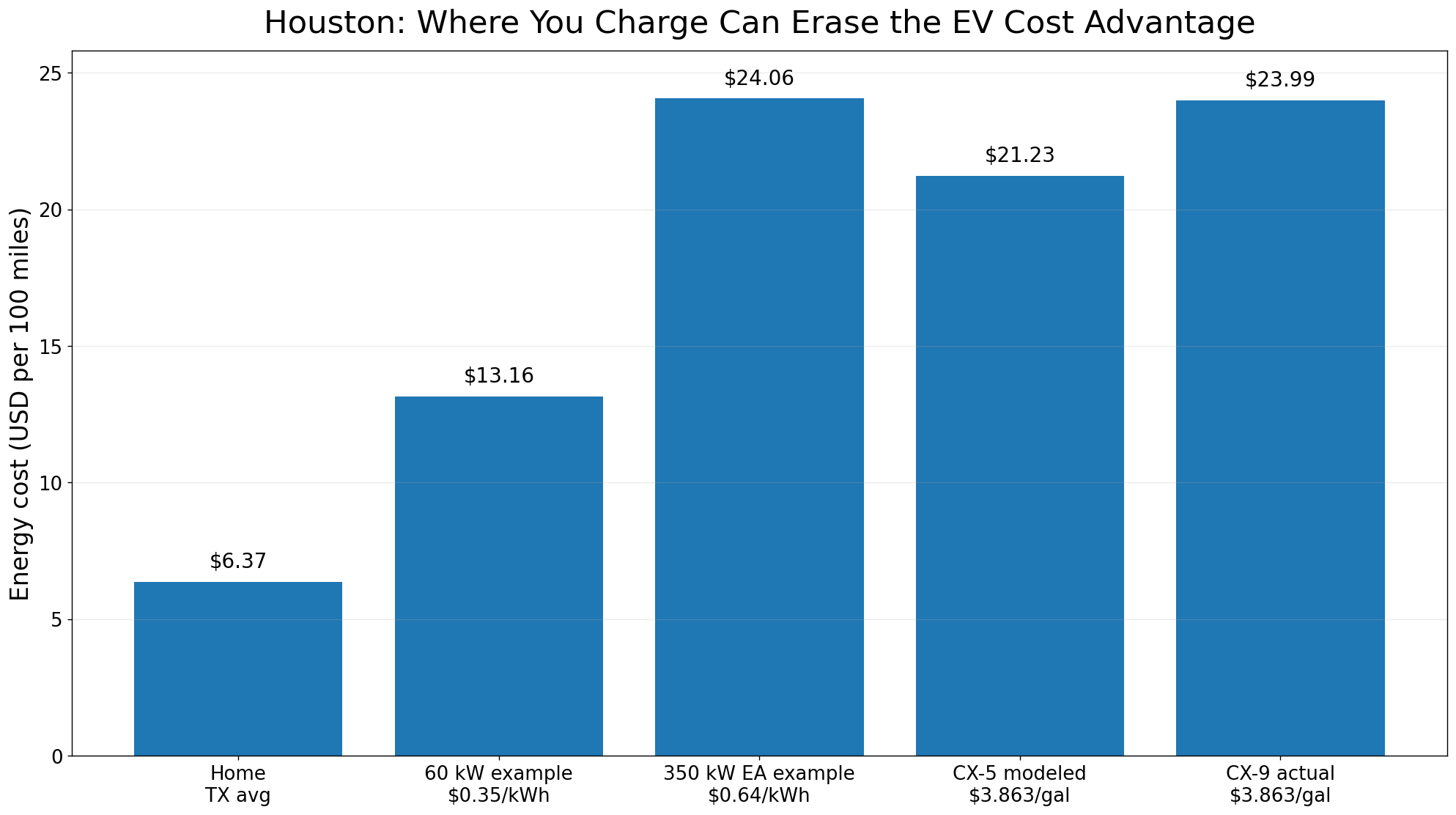
The 2023 Ariya is also limited to roughly 130 kW DC fast charging, so plugging into a 350 kW dispenser does not mean the car receives 350 kW. Nissan lists the 7.2 kW onboard AC charger and up-to-130 kW DC fast-charging capability. [10]
7. Can choosing the charger bring the savings back?
Sometimes, yes — but the important variable is not simply 50/60 kW versus 350 kW. In the September 22 study snapshot, Houston included a 60 kW EVBOLT example at $0.35/kWh, while some 350–400 kW sites were also around $0.35–$0.39/kWh. Network, location, time of day and membership can matter more than the power label. [15]
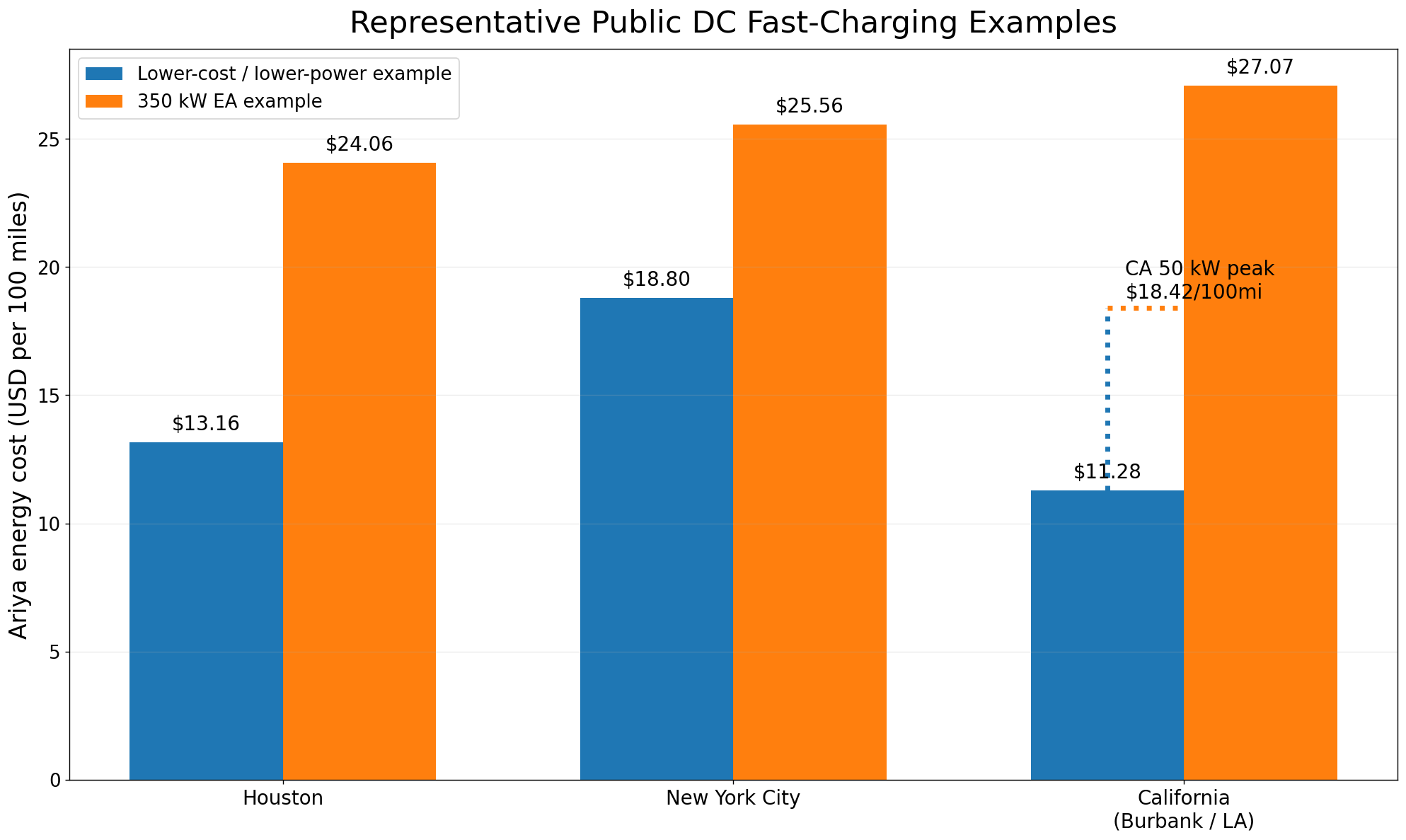
- Houston: 60 kW at $0.35/kWh → about $13.16/100 mi; EA 350 kW at $0.64 → about $24.06.
- New York City: a ChargePoint $0.50/kWh example → about $18.80; Flushing EA 350 kW at $0.68 → about $25.56.
- California: Burbank 50 kW at $0.30 off-peak → about $11.28; $0.49 peak → about $18.42; Los Angeles EA 350 kW at $0.72 → about $27.07.
There is a time tradeoff. Treating 100 miles as roughly 37.6 kWh of purchased DC energy in this sensitivity model, the theoretical energy-delivery time is about 45 minutes at 50 kW, 38 minutes at 60 kW and 17 minutes at 130 kW. Real sessions can be slower because of SOC, battery temperature, the charging curve and site power sharing.
8. Texas charges EVs another $200 a year. Does that change the answer?
Texas assesses a separate $200 annual fee on fully electric cars and light trucks at registration renewal; a new EV issued two years of registration is assessed $400. [16]
At 12,000 miles/year, subtracting that $200 from the home-charging savings still leaves about $1,648/year versus the modeled CX-5 and $1,988/year versus our measured CX-9 in this September 22 snapshot.
Spread over 12,000 miles, the fee is about $1.67 per 100 miles. Under this model, the gasoline price that makes the Ariya equal the modeled CX-5 is roughly $1.46/gal; versus the measured CX-9, roughly $1.29/gal.
9. Maintenance probably helps the EV — but I did not add it to the savings number
DOE's general light-duty model estimates scheduled maintenance at 6.1¢/mile for a BEV and 10.1¢/mile for an ICEV. A BEV does not have engine oil, spark plugs, timing belts and several other ICE-specific service items; regenerative braking can also reduce friction-brake use. [17]
But those are not Ariya-vs-CX-9 measured maintenance costs. I also do not yet have enough tire-replacement history on our Ariya to quantify the possible tire-wear penalty from EV weight, torque and tire choice. So the $1,648 / $1,988 annual figures above do not include a maintenance advantage.
Conclusion: home charging was the real economic advantage
This started as a simple memory check: “Was Houston gas really about $2 just a few months ago?” The answer was yes — and individual stations really did show $1.90–$1.94.
But the more interesting result came after the EV comparison. Even at the $1.94 stress-test price, our Ariya home-charging model stayed cheaper. Then the result almost vanished when I moved the same Ariya to an expensive 350 kW public charger.
- Houston really was in the low $2s in early 2026.
- Sub-$2 station prices were documented, but they were not the city average.
- Home charging remained cheaper than both gasoline comparisons in the TX/NY/CA snapshot.
- Public DCFC can vary dramatically by site, network and time of day; in Texas, expensive DCFC can erase the EV advantage.
- Texas' extra $200 BEV fee did not erase the home-charging advantage at 12,000 miles/year in this model.
- Maintenance is likely another EV tailwind, but I kept it out of the annual savings because I do not have vehicle-specific measured data yet.
So “Is an EV cheaper?” turned out to be the wrong first question. The more useful question was: where can you charge, and what does that electricity actually cost? For our household, cheap home charging is the biggest economic advantage.
After looking at today's EV energy cost, I dug into Honda's D-WPT concept: resonance, coupling, predictive-control possibilities, buried-road durability, and economics. For passenger cars, it ultimately competes with cheap home charging and improving batteries.
Method and limitations
- Ariya 2.8 mi/kWh and CX-9 16.1 mpg are dashboard measurements from our vehicles.
- The CX-5 18.2 mpg figure is modeled from the CX-9 real/EPA ratio; it is not measured.
- The 89.3% home-charging efficiency is an EPA MOVES reference value, not a Nissan-specific specification.
- The 5% DC charging loss is a sensitivity assumption.
- Public charging prices are individual station listings and can change with membership, time of day and network pricing.
- Purchase price, incentives, insurance, depreciation and financing are outside this comparison.
- All $/100-mile figures are energy-cost comparisons, not full total cost of ownership.
References
- U.S. Energy Information Administration (EIA), Houston Regular All Formulations Retail Gasoline Prices.
- EIA, New York Regular All Formulations Retail Gasoline Prices.
- EIA, California Regular All Formulations Retail Gasoline Prices.
- Houston Chronicle, Houston gas prices dip to $2.41 as holidays approach (Dec. 2, 2025; Houston low $2.09).
- Houston Chronicle, Gas prices drop for fourth week (Dec. 22, 2025; Houston low $1.90).
- Houston Chronicle, GasBuddy forecasts 2026 gas prices (Jan. 6, 2026; Market At Beamer $1.94 cash).
- Houston Chronicle, Houston gas prices jump by more than $1 (Mar. 31, 2026; average ~$3.55, low $3.19).
- Mazda USA, 2020 CX-9 Features & Specifications.
- Mazda USA, 2020 CX-5 Features & Specifications.
- Nissan USA, 2023 Nissan Ariya Brochure.
- U.S. EPA, Emission Adjustments for Onroad Vehicles in MOVES4 (95% battery efficiency, 94% charging efficiency, 89.3% combined wall-to-output for new EVs).
- EIA, Electric Power Monthly — Back Issues; August 2026 release, Table 5.6.A (June 2026 state residential electricity prices).
- AAA Gas Prices, state pages used for the frozen Sept. 22, 2026 study snapshot: Texas, New York, California. Daily values change; this article uses the values recorded during the study.
- DCFC Tracker, Electrify America Walmart 5959, Houston.
- DCFC Tracker station/network listings used for representative charging examples: Texas, New York, Flushing EA 350 kW, Burbank 50 kW, Los Angeles EA 350 kW. Rates may change.
- Texas Department of Motor Vehicles, Register Your Vehicle — Electric Vehicles.
- U.S. Department of Energy, Battery-Electric Vehicles Have Lower Scheduled Maintenance Costs.
- EIA, Houston Gasoline and Diesel Retail Prices — Weekly (Regular gasoline: $3.863/gal on Sept. 21, 2026).
Questions or comments about this article?
If you have your own real-world EV efficiency, public-charging prices, or Houston fuel-price observations, feel free to send a note.
The website is where I organize the completed analysis. Price checks, quick calculations and experiments in progress go to @ConyDIYHouston.