
Can a $1,150 BeerDroid Pay for Itself?
Witbier Cost vs. Packaged Beer, Growlers and Bars
After designing my 10 L (2.6 gal) Hoegaarden-inspired Witbier v1 in Brewfather, the next question was obvious: what does a pint actually cost? I compared BrewArt Team's clone with my MoreBeer-based recipe, including ingredients, keg consumables, sanitizer, water, measured electricity and stove heat—then added the $1,150 equipment cost over one, three and five years.
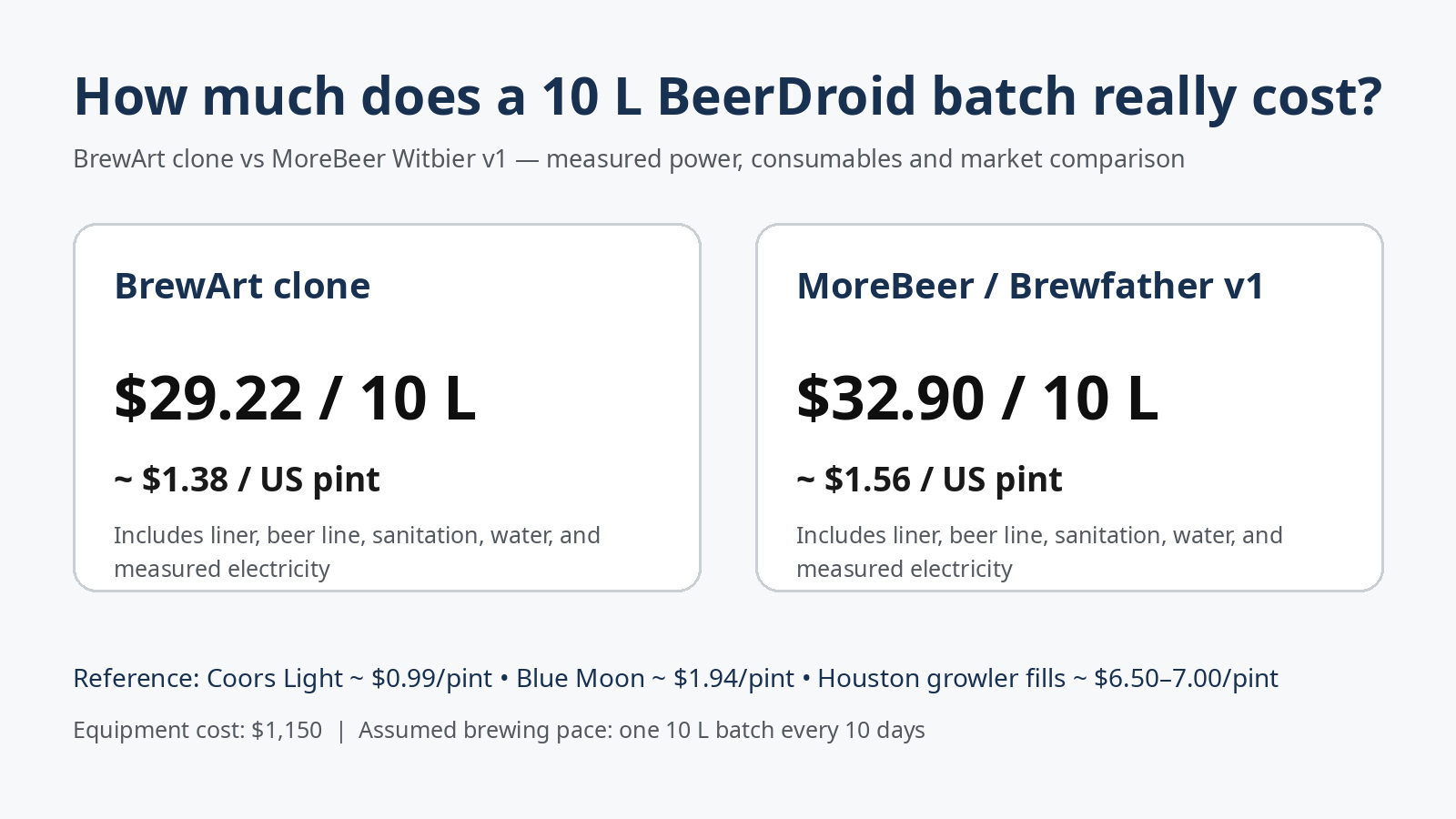
The result up front
It does not beat a case of Coors Light at about $0.99 per US pint. But at my assumed pace of one 10 L batch every 10 days, the BrewArt clone lands very close to a $1.94-per-pint Blue Moon reference after three years. Houston-area 64 oz growler fills in my examples run $26–28 ($6.50–7.00 per pint), while local craft draft examples are around $7–8 per serving. Even an aggressive one-year equipment write-off stays well below those craft-beer references.[15][16][17][18][19]
Designing a BeerDroid 10 L Witbier in Brewfather →
1. Two ways to build the same general beer idea
The starting point is BrewArt Team's Hoegaarden Wheat Clone: E5 ×1, X2 ×4, Y5 ×1, 2 g coriander and 3.5 g orange peel for 10 L. The spice method is simple: bring 1 L of water to a boil, turn the heat off, steep the spices for 30 minutes, then combine with the rest of the brewing water.[1] Current BrewArt list prices are $4.00 for E5, $3.50 for X2 and $3.50 for Y5.[2][3][4]
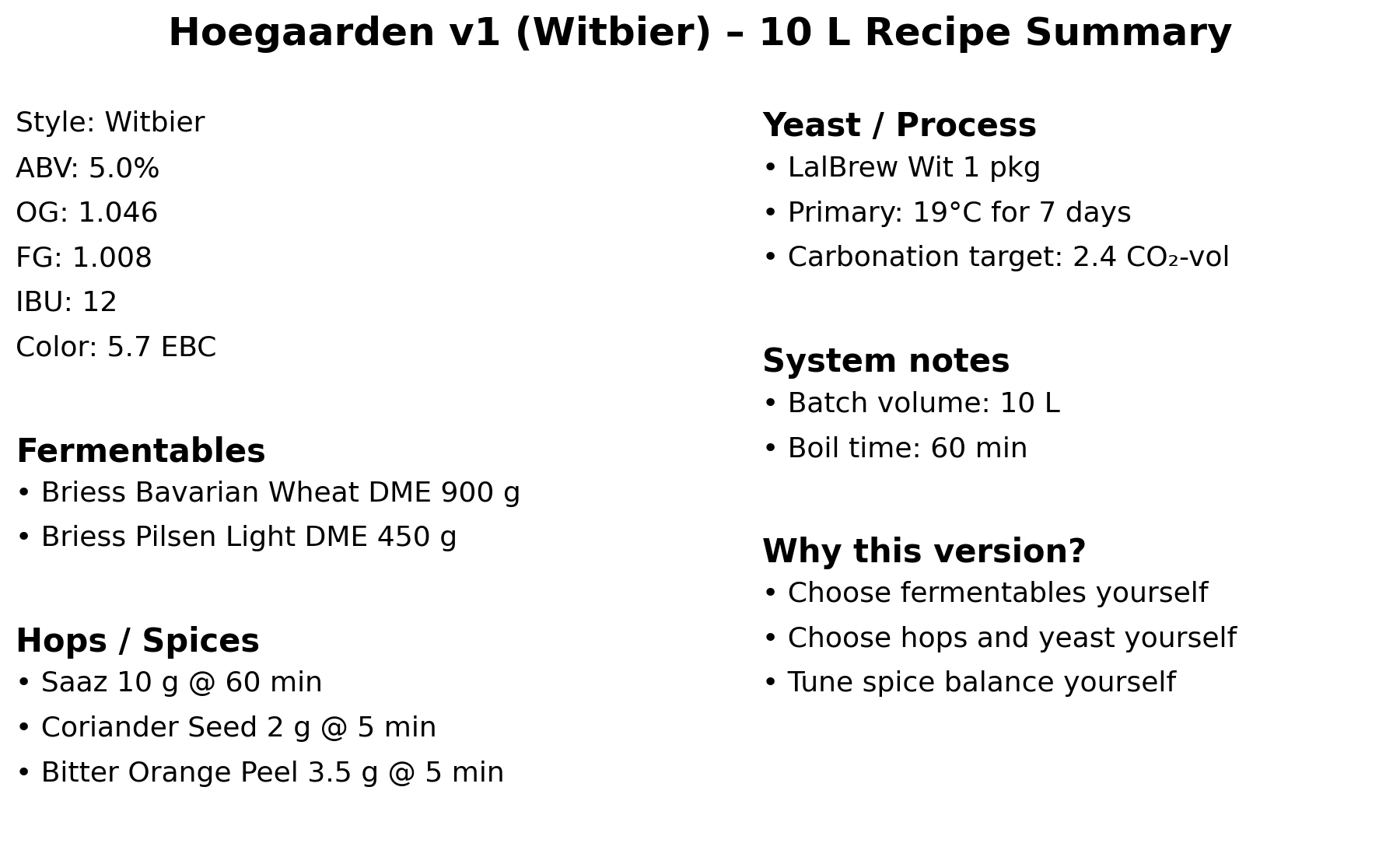
My MoreBeer/Brewfather version uses 900 g Bavarian Wheat DME, 450 g Pilsen Light DME, 10 g Saaz for 60 minutes, 2 g coriander and 3.5 g bitter orange peel at 5 minutes, plus one pack of LalBrew Wit.[5][6][7][8][9][10]
2. I stopped estimating electricity and measured it
Electricity was the biggest unknown, so I put smart plugs on both machines.
| Equipment | Measured window | Energy |
|---|---|---|
| BeerDroid | One batch, about 7 days | 1.664 kWh |
| BrewFlo | One 5 L keg | 1.469 kWh |
| BrewFlo, 10 L equivalent | Two 5 L kegs | 2.938 kWh |
| Total | One 10 L batch | 4.602 kWh |
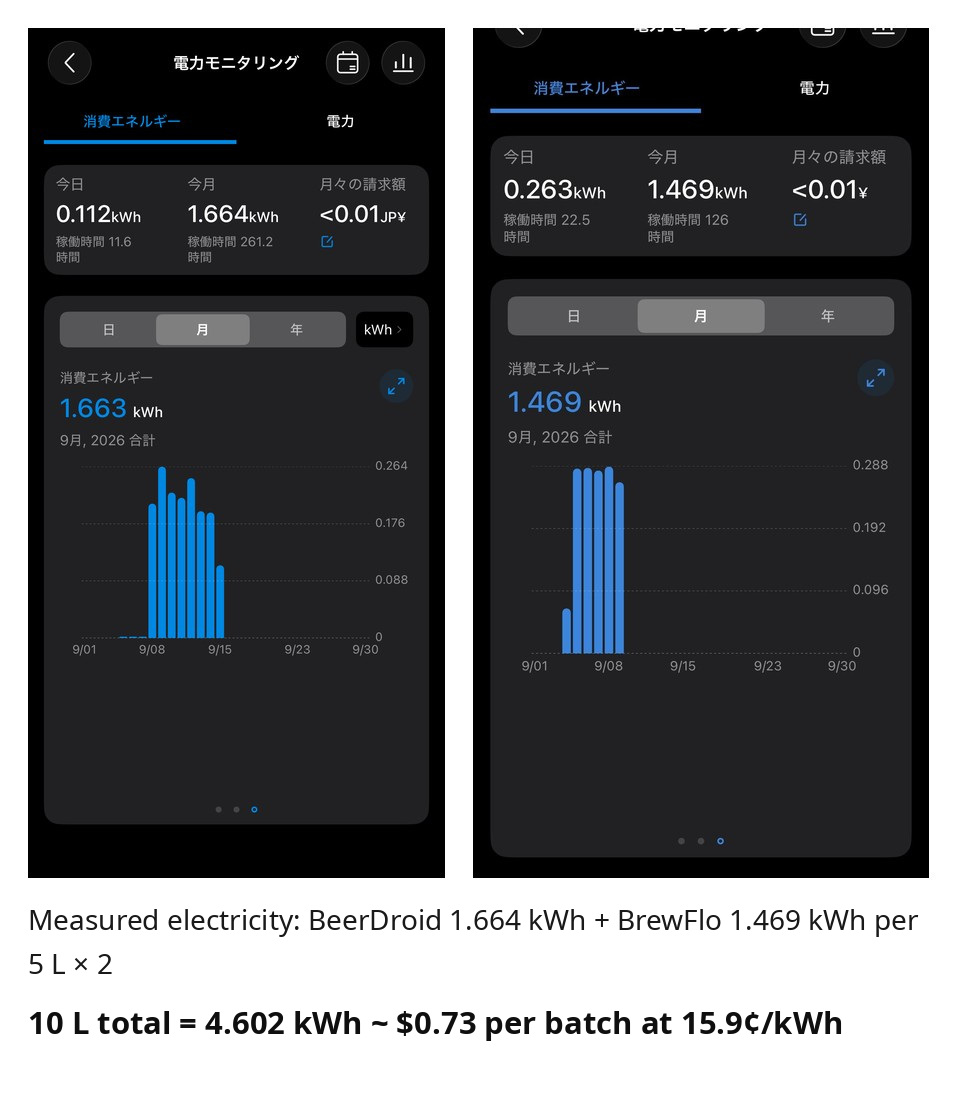
Using the EIA's June 2026 Texas residential average of 15.94¢/kWh, that is about $0.73 per 10 L batch, or roughly 3.5¢ per US pint.[13] Electricity turned out to matter much less than ingredients and keg liners.
3. Shopping-cart total is not the same as batch cost
The MoreBeer recipe leaves leftovers. DME, hops, coriander, orange peel and dextrose are purchased in packages, so I do not charge the whole shopping cart to one batch. For this article I used the regular-price basis from my shopping plan, excluding the 20% sale discount, and allocated only the amount actually used in 10 L.
E5, X2 and Y5 are easy to price because the required units are used directly in one batch. Only spices and priming sugar need to be prorated.
Several packages carry over to later batches. The main advantage is not necessarily the lowest cost—it is recipe freedom.
4. Looking at ingredient costs, the yeast difference jumps out
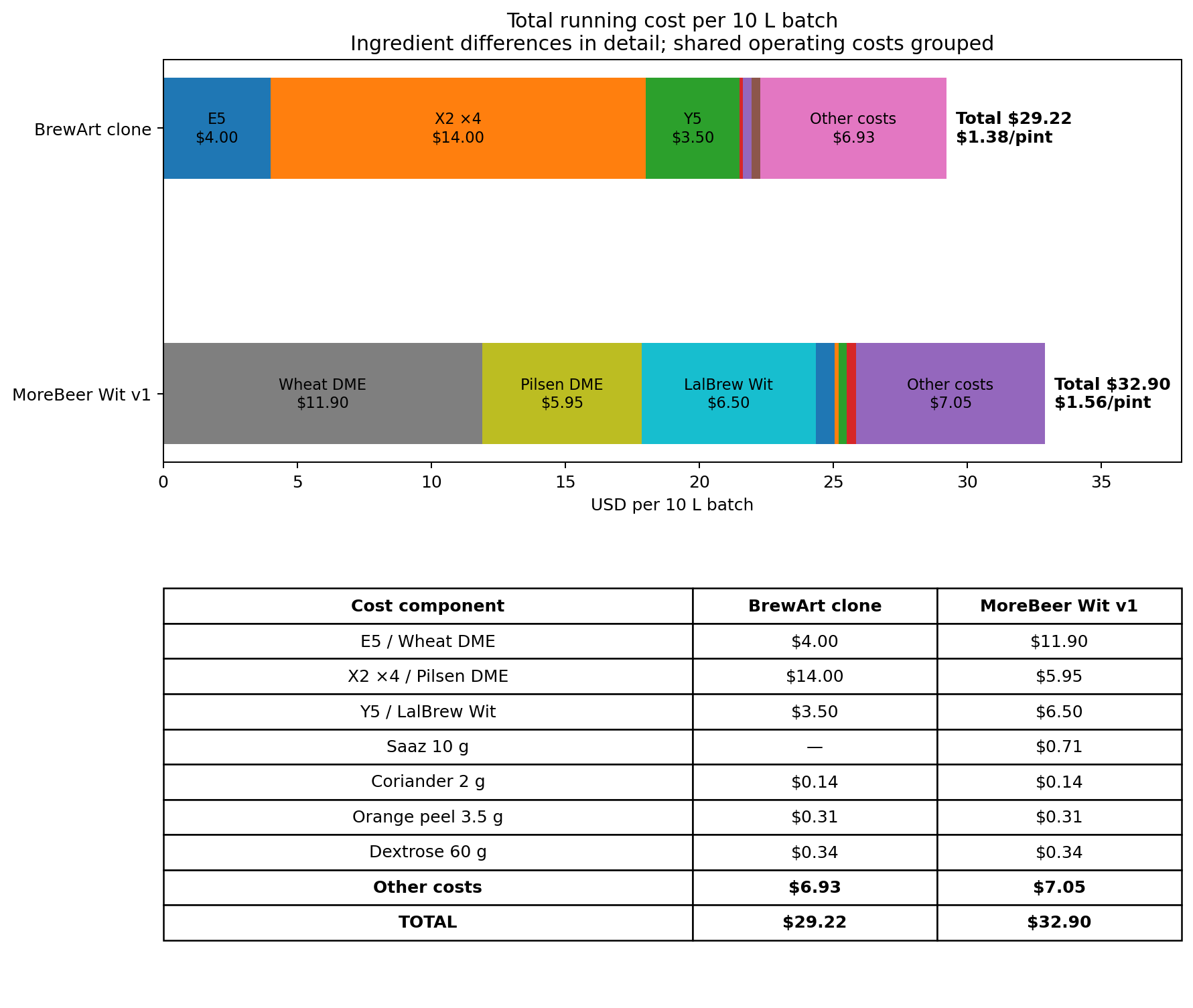
| Cost component | BrewArt clone | MoreBeer Wit v1 |
|---|---|---|
| Base ingredient 1 | E5 $4.00 | Wheat DME $11.90 |
| Base ingredient 2 | X2 ×4 $14.00 | Pilsen DME $5.95 |
| Yeast | Y5 $3.50 | LalBrew Wit $6.50 |
| Saaz | — | $0.71 |
| Coriander | $0.14 | $0.14 |
| Orange peel | $0.31 | $0.31 |
| Dextrose | $0.34 | $0.34 |
| Other costs | $6.93 | $7.05 |
| Total / 10 L | $29.22 | $32.90 |
| Per US pint | $1.38 | $1.56 |
The standard-cost gap is about $3.68 per 10 L, and yeast is one of the clearest reasons. That matters later when I model yeast reuse.
5. What is inside “Other costs”?
| Item | Assumption | Per batch |
|---|---|---|
| Keg liners | Two liners per 10 L | $5.00 |
| Beer line | One line used for 10 batches | $0.25 |
| Star San | 5 L sanitizer solution | $0.59 |
| Droid Cleanse | Once every five batches | $0.30 |
| Tap water | Included even though small | about $0.03 |
| BeerDroid + BrewFlo electricity use | Measured 4.602 kWh | $0.73 |
| Stove heat | BrewArt: boil 1 L then off-heat steep / MoreBeer: 60-minute boil | about $0.03 / $0.15 |
BrewArt currently lists Keg Liners and Beer Lines at $10 each and Droid Cleanse at $1.50.[12] MoreBeer lists Star San at a 1 oz per 5 gal working dilution.[11] The gas figures are rough estimates using Texas residential natural-gas pricing; actual stove efficiency will vary.[14]
BrewArt describes liners and beer lines as disposable. My standard model uses a new liner every batch, while the beer-line assumption reflects my own cleaned/sanitized operating plan.
6. Adding the $1,150 equipment cost
I used one 10 L batch every 10 days—about 36.5 batches, 365 L (96.4 US gal), or 771 US pints per year.
| Cost model | BrewArt clone | MoreBeer Wit v1 |
|---|---|---|
| Running only | $1.38 | $1.56 |
| 1-year equipment amortization | $2.87 | $3.05 |
| 3-year equipment amortization | $1.88 | $2.05 |
| 5-year equipment amortization | $1.68 | $1.85 |
The number I cared most about was the three-year line: about $1.88 per pint for the BrewArt clone, very close to the Blue Moon reference of about $1.94.
7. Coors, Blue Moon, growlers and taproom beer
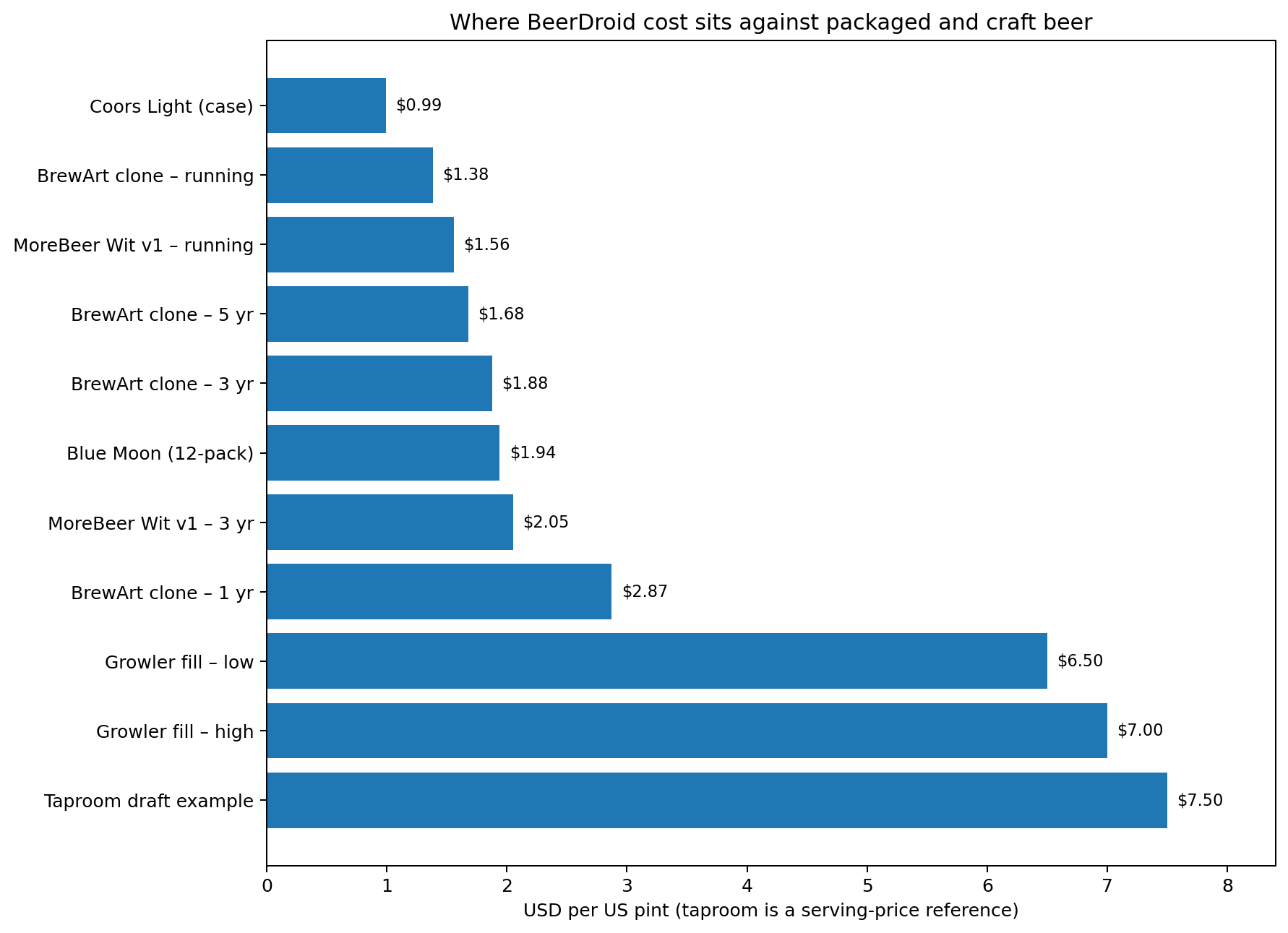
| Reference | Example price | Normalized cost |
|---|---|---|
| Coors Light 24 × 12 oz | $17.87 | about $0.99/pint |
| BrewArt clone, running only | $29.22 / 10 L | $1.38/pint |
| MoreBeer v1, running only | $32.90 / 10 L | $1.56/pint |
| BrewArt clone, 3-year equipment | equipment included | $1.88/pint |
| Blue Moon 12 × 12 oz | $17.47 | about $1.94/pint |
| BrewArt clone, 1-year equipment | equipment included | $2.87/pint |
| Houston-area growler fill | 64 oz $26–28 | $6.50–7.00/pint |
| Houston craft draft examples | about $7–8 / serving | experience-price reference; pour size varies |
H-E-B prices vary by store and fulfillment method, so these are snapshots, not universal Houston prices.[15][16] For growlers, Senate Avenue Brewing shows a $26 64 oz fill and Fortress BeerWorks shows a $28 64 oz option.[17][18] Botanic Beer Garden lists several Houston craft drafts at $7–8.[19]
BeerDroid is not a machine for beating the cheapest light lager. It makes much more sense as a way to keep craft-leaning beer at home, while also giving me control over the recipe and the process.
8. If I push cost down further, yeast reuse matters
This section is a what-if model, not my standard cost. I modeled five batches per yeast pitch and two batches per liner.
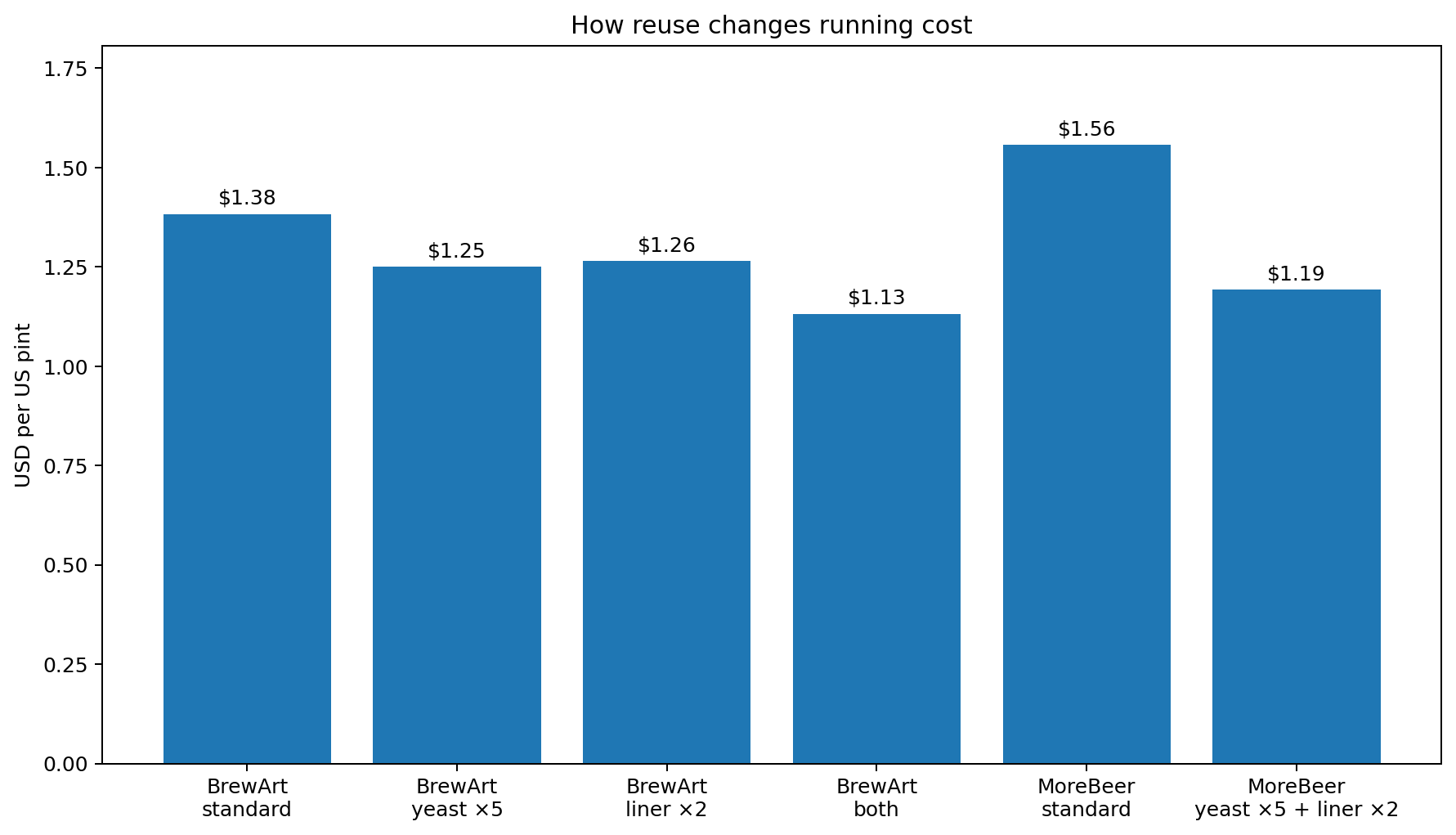
| Scenario | USD / pint |
|---|---|
| BrewArt standard | $1.38 |
| BrewArt: yeast across 5 batches | $1.25 |
| BrewArt: liner across 2 batches | $1.26 |
| BrewArt: both | $1.13 |
| MoreBeer standard | $1.56 |
| MoreBeer: yeast ×5 + liner ×2 | $1.19 |
Y5 is $3.50 and LalBrew Wit is $6.50. Spread those over five batches and the average yeast cost becomes $0.70 versus $1.30. The standard $3.68-per-batch gap between the recipes shrinks to about $1.28 after yeast reuse.
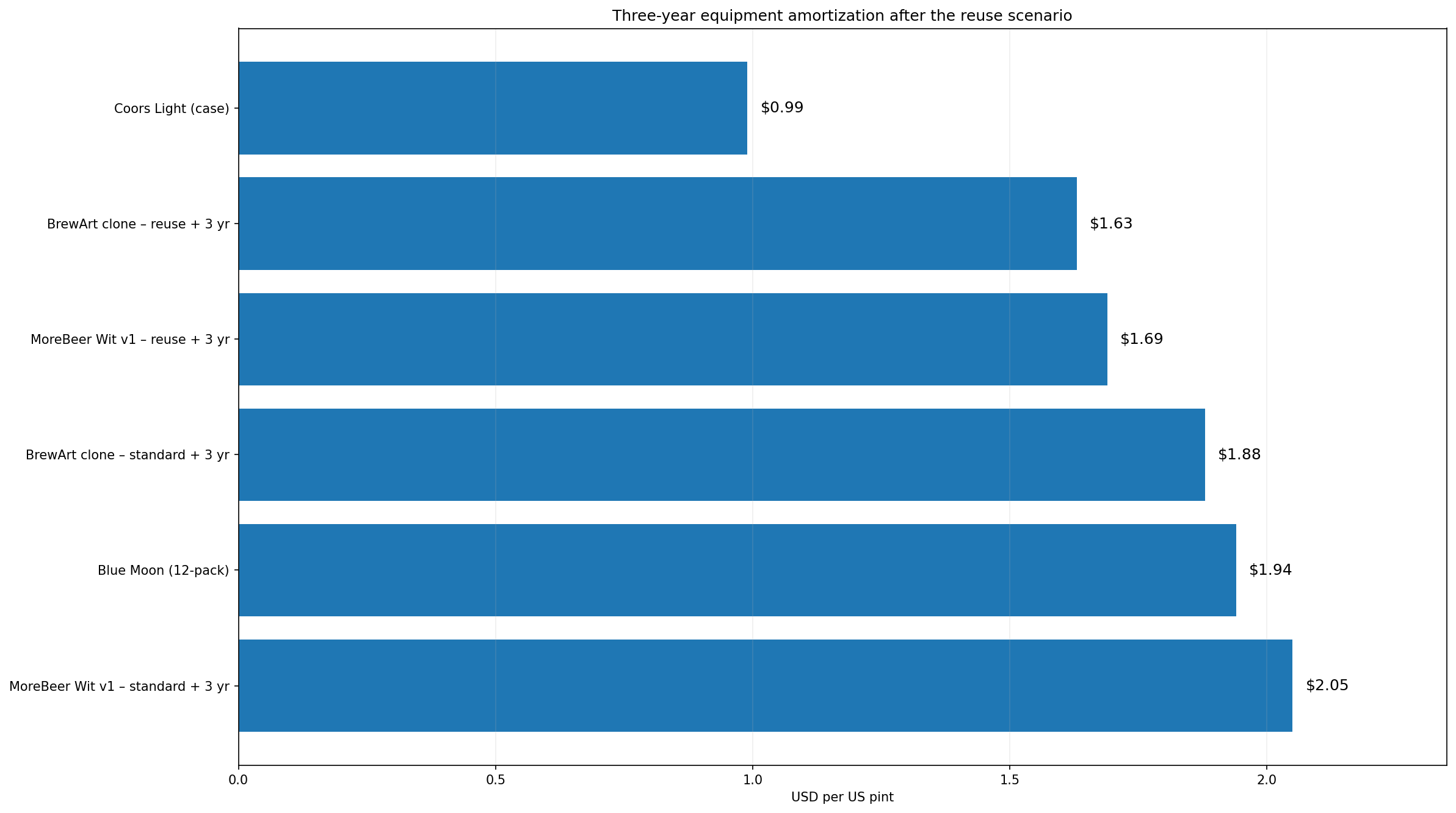
If five batches per yeast pitch and two batches per liner actually work in practice, then adding the three-year share of the $1,150 equipment cost gives about $1.63 per US pint for the BrewArt clone and $1.69 per US pint for the MoreBeer Wit v1. That puts even the MoreBeer version comfortably near the Blue Moon reference of about $1.94 per pint. This is still a what-if scenario, not my standard operating cost, and the reuse assumptions need to be tested separately.
Yeast reuse introduces sanitation, generation-management and fermentation-character questions. BrewArt liners are designed as disposable items. I would rather treat both as separate experiments than hide them inside the baseline number.
9. Shopping list
- Briess Bavarian Wheat DME →
- Briess Pilsen Light DME →
- Czech Saaz Pellet Hops →
- Coriander Seed →
- Bitter Orange Peel →
- LalBrew Wit →
- Dextrose / Corn Sugar →
- View Star San on Amazon →
Prices and availability change.
Conclusion: Coors wins on price. That is not really the point.
The math confirmed something useful: BeerDroid will not beat the cheapest mass-produced lager. But at a high-use pace, the BrewArt clone gets into Blue Moon territory once the equipment is spread over a few years.
The MoreBeer version costs a bit more, but it lets me choose the extract, hops, yeast and spice balance. I can change fermentation temperature, measure electricity, compare ingredients, revise the recipe and try again. The value is not just cheap beer; it is having a small brewing test bench at home.
This is still the v1 cost model. Next I plan to brew the BrewArt Team clone first, then brew the MoreBeer version as well, so I can compare fermentation, flavor, and the real-world cost of both approaches.
References
- BrewArt Team, Hoegaarden Wheat Clone (ingredient list and 1 L spice infusion method)
- BrewArt, Elements (E5 $4.00)
- BrewArt, Enhancers (X2 $3.50)
- BrewArt, Yeasts (Y5 $3.50)
- MoreBeer, Briess Bavarian Wheat DME
- MoreBeer, Briess Pilsen Light DME
- MoreBeer, LalBrew Wit (11 g regular price $6.49 at check time)
- MoreBeer, Czech Saaz Pellet Hops
- MoreBeer, Coriander Seed (1 oz $1.99)
- MoreBeer, Bitter Orange Peel (1 oz $2.49)
- MoreBeer / Five Star, Star San 8 oz (1 oz per 5 gal dilution)
- BrewArt, Supplies (Keg Liners $10, Beer Lines $10, Droid Cleanse $1.50)
- U.S. EIA, Average Price of Electricity by State, June 2026 (Texas residential 15.94¢/kWh)
- U.S. EIA, Texas Natural Gas Prices (June 2026 residential $31.89 per 1,000 cu ft)
- H-E-B, Coors Light 24 × 12 oz ($17.87 at comparison time)
- H-E-B, Blue Moon Belgian White 12 × 12 oz ($17.47 at comparison time; store pricing varies)
- Senate Avenue Brewing, 64 oz Growler Fill ($26 example)
- Fortress BeerWorks, 64 oz Growler ($28 example)
- Botanic Beer Garden, Draft Beer Menu (Houston craft draft examples at $7–8)
Questions or comments about this article?
If you have questions about the BeerDroid cost model, ingredient shopping, the Witbier recipe, measured electricity, or equipment amortization, feel free to send a note.
The X series walks through measured electricity, ingredients and consumables, market comparisons, and cost-cutting scenarios. This web version brings the assumptions, calculations, and sources together in one place.