
Does a Chicken Really Have Only One Yagen Cartilage?
A Costco Rotisserie Chicken Made Me Look It Up
I had bought yagen cartilage in packs before, but carving a whole chicken made the anatomy suddenly click. “Yagen” is the Japanese term used for this cartilage at the tip of the breastbone. One bird has one central yagen cartilage—while tenderloins, wings, and thighs come in pairs.
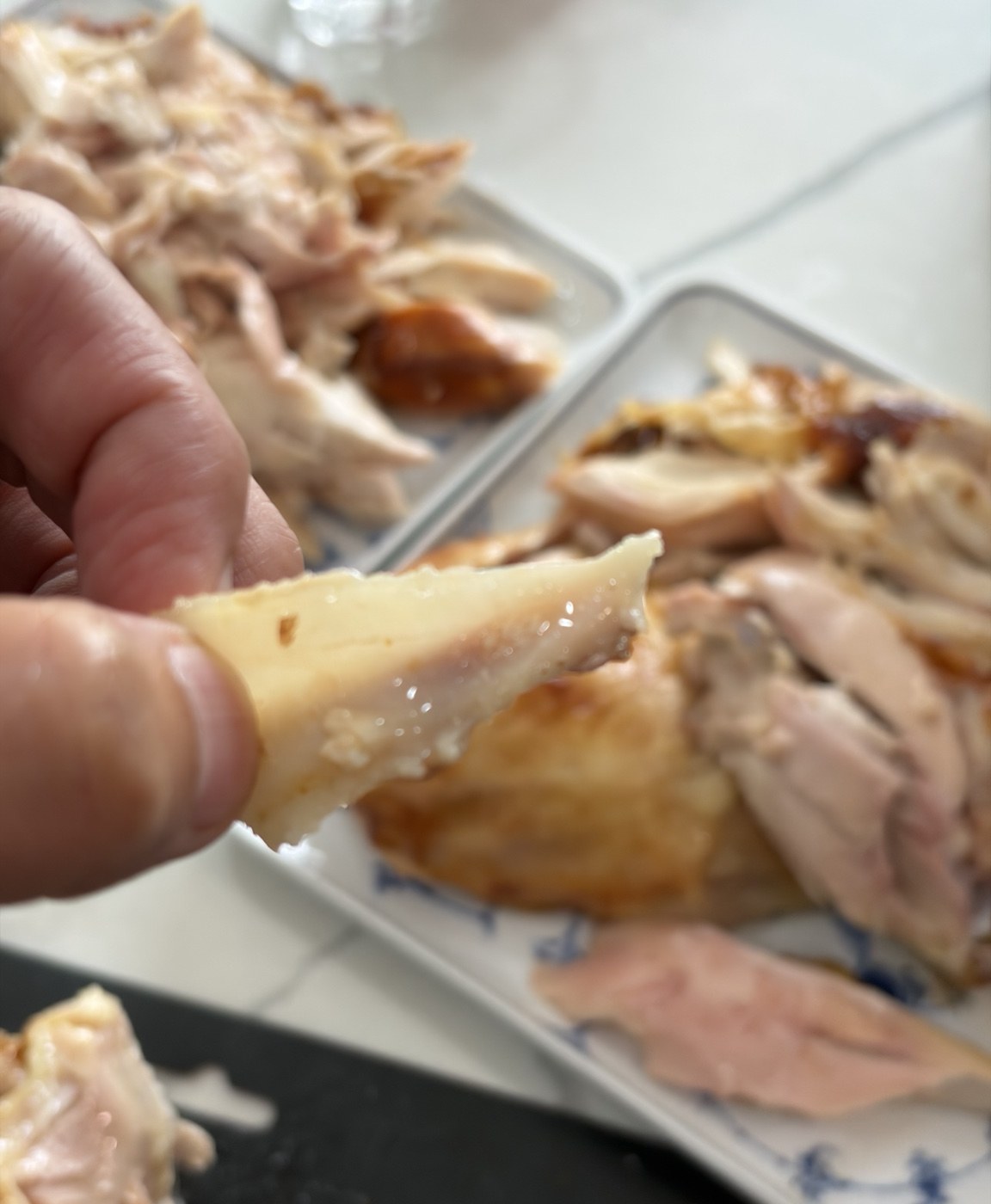
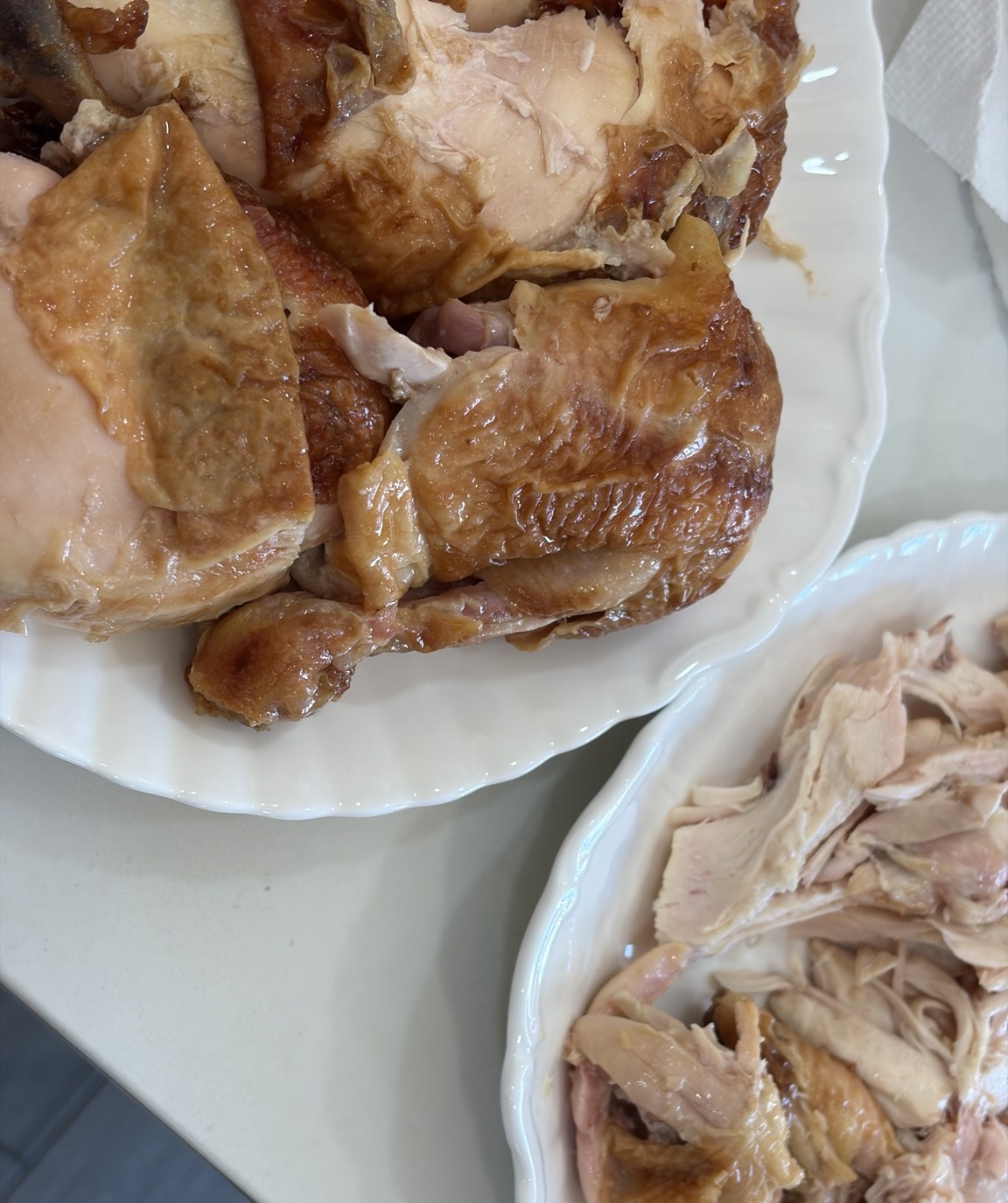
While carving a Costco rotisserie chicken, I found a firm, boat-shaped piece of cartilage near the center of the breast. In Japan this part is commonly sold and eaten as yagen cartilage; anatomically, it is the cartilaginous tip of the sternum (breastbone). This was the first time I had actually removed one from a whole bird myself.
Japan's Ministry of Agriculture, Forestry and Fisheries identifies yagen as cartilage at the tip of the breastbone.[1] A commercial product description also explicitly describes it as one per bird.[5] That matches the anatomy: it is a single central structure, not one on each side of the chicken.
Quick answer: how many of these cuts does one chicken have?
| Cut / part | Per chicken | Location |
|---|---|---|
| Yagen cartilage | 1 | Tip of the breastbone, on the center line[1][5] |
| Tenderloins (sasami) | 2 | Inside the breast, one along each side of the sternum |
| Breast halves | 2 halves | Left and right side of the breast |
| Wings | 2 | One on each side |
| Thighs | 2 | One on each leg |
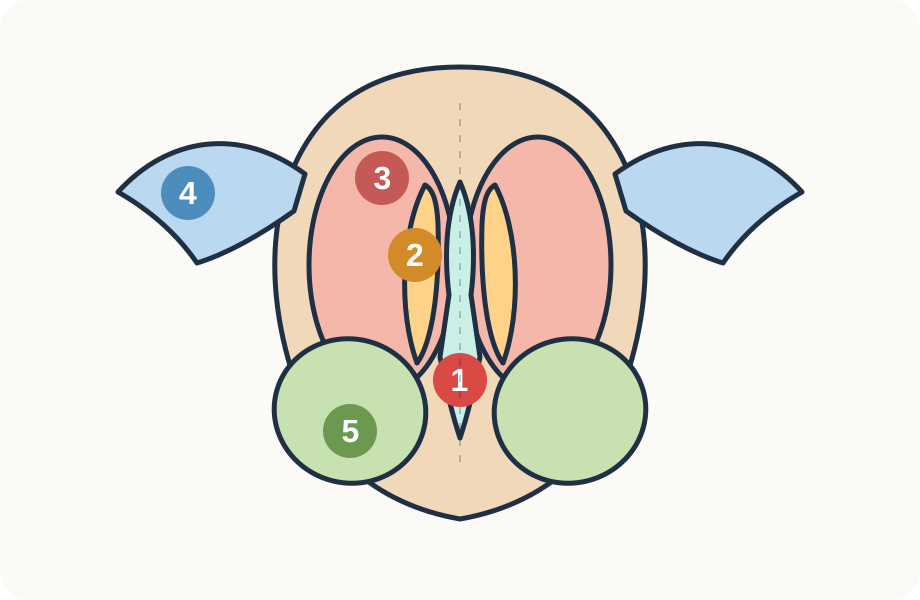
The difference is easy to see in a simple diagram
So how many chickens are in one supermarket pack of yagen?
That led to the more entertaining question. If there is only one yagen per bird, how many chickens are represented by a 150 g, 300 g, or 500 g package?
The commercial product descriptions I found are not perfectly consistent: one describes roughly 20 g per bird, while another gives roughly 30 g.[4][5] That difference makes sense because the bird size and the amount of breast meat left attached to the cartilage can vary.
This is not a scientific standard and it should not be treated as an exact bird count—especially for meat-on or seasoned products.
| Pack weight | Rough equivalent |
|---|---|
| 150 g | about 5–8 chickens |
| 200 g | about 7–10 chickens |
| 300 g | about 10–15 chickens |
| 500 g | about 17–25 chickens |
| 1 kg | about 33–50 chickens |
A 300 g pack works out to roughly 10–15 birds using that broad range. Thinking in whole birds makes the same supermarket package feel very different.
One important caveat: pieces in the pack do not equal birds
One chicken has one anatomical yagen cartilage, but that cartilage can be cut into multiple pieces before packaging. Meat-on yagen can also include very different amounts of surrounding breast meat.
So 20 pieces in a package do not necessarily mean 20 chickens. The calculation above is simply a way to understand the scale from package weight.
A whole bird connects the cut back to the animal
Two tenderloins make more sense when you see one tucked along each side of the breastbone. Two wings and two thighs are obvious once the bird is in front of you. Yagen is different: it is the single piece running down the middle.
That was the fun part of this little question. I started by carving a Costco rotisserie chicken and ended up looking at a 300 g supermarket pack as the product of more than ten birds.
Bottom line
Yagen cartilage sits at the tip of the breastbone and there is one per chicken. Tenderloins, wings, thighs, and breast halves are paired. Using a rough commercial range of 20–30 g of yagen per bird, a 300 g pack represents roughly 10–15 birds.
The weight estimate is only a scale reference; trimming and attached meat can change it substantially.
Research. Try. Fail. Learn. Enjoy.
References
- Japan Ministry of Agriculture, Forestry and Fisheries (MAFF), Chicken Cuts Guide — identifies yagen as cartilage at the tip of the breastbone. PDF (Japanese)
- MAFF, Chicken Feature — describes sasami/tenderloins as one on each side along the breastbone. Official page (Japanese)
- USDA Agricultural Marketing Service, Poultry Grading Manual — defines tenderloins as the inner pectoral muscle alongside the sternum. PDF
- Manpuku Shokudo Store product description — states about 20 g of yagen per bird. Product page (Japanese)
- Hokkaido 4129-ya product description — states one yagen per bird, about 30 g. Product page (Japanese)
The 20–30 g range is a practical estimate drawn from commercial product descriptions, not an anatomical standard. Actual weight varies with bird size, trimming, attached meat, and seasoning.
Questions or comments about this article?
If there is another chicken cut that makes you wonder “how many per bird?”, feel free to send it in.
I post quick discoveries, experiments, and works in progress from daily life in Houston on X.